Realtek Outlines SSD Controller Roadmap: High-End PCIe 5.0 x4 Platform in the Works
Published: Jun 13nd 2024 12:00am on AnandTech
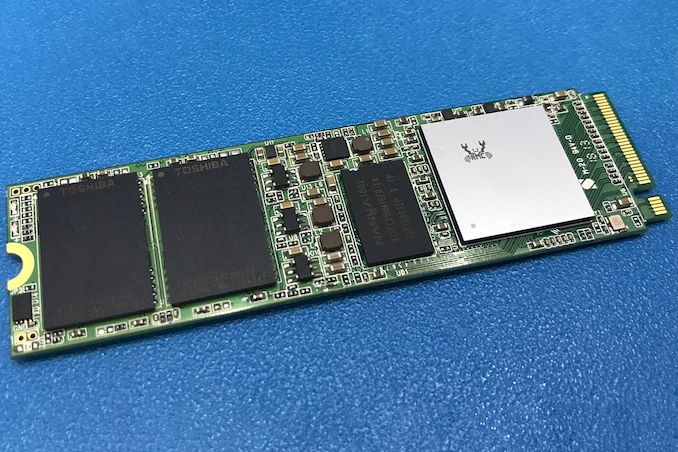
While Realtek is best known in the enthusiast space for for its peripheral controllers such as audio codecs and network controllers, the company also has a small-but-respectable SSD controller business that tends to fly under the radar due to its focus on entry-level and mainstream drives. But Realtek's stature in the SSD space is on the rise, as the company is not only planning new PCIe Gen5 SSD controllers, but also their first high-end, DRAM-equipped SSD controller.
For this year's Computex trade show, Realtek laid out a new SSD controller roadmap that calls for the company to release a trio of new SSD controllers over the next couple of years. First up is a new four-channel entry-level PCIe 4.0 controller, the RTS5776DL, which will be joined a bit later by a PCIe 5.0 variant, the RTS5781DL. But most interesting on Realtek's new roadmap is the final chip being planned: the eight-channel, DRAM-equipped RTS5782, which would be the company's first high-end SSD controller, capable of hitting sequential read rates as high as 14GB/second.
Realtek NVMe SSD Controller Comparison RTS5782 RTS5781DL RTS5776DL RTS5772DL RTS5766DL Market Segment High-End Mainstream Entry-Level Error Correction 4K LDPC 2K LDPC DRAM DDR4, LPDDR4(X) No No No No Host Interface PCIe 5.0 x4 PCIe 5.0 x4 PCIe 4.0 x4 PCIe 4.0 x4 PCIe 3.0 x4 NVMe Version NVMe 2.0 NVMe 2.0 NVMe 2.0 NVMe 1.4 NVMe 1.4 NAND Channels, Interface Speed 8 ch, 3600 MT/s 4 ch, 3600 MT/s 4 ch, 3600 MT/s 8 ch, 1600 MT/s 4 ch, 1200 MT/s Sequential Read 14 GB/s 10 GB/s 7.4 GB/s 6 GB/s 3.2 GB/s Sequential Write 12 GB/s 10 GB/s 7.4 GB/s 6 GB/s 2.2 GB/s 4KB Random Read IOPS 2500k 1400k 1200k - - 4KB Random Write IOPS 2500k 1400k 1200k - -Diving a bit deeper into Realtek's roadmap, the RTS5776DL is traditional DRAM-less PCIe Gen4 x4 controller with four NAND channels, and is aimed at entry-level drives. The controller's NAND support is quite modern, however, supporting the latest ONFI/Toggle standards, which will allow it to hit NAND transfer rates up to 3600 MT/second. Across four channels, that's enough bandwidth to fully saturate a PCIe 4.0 x4 connection with sequential read/writes, while random 4K IOPS can burst as high as 1.2 million. Engineering samples of the controller are set to emerge in Q4 2024, so do not expect actual drives based on this chip to emerge for sale until the second half of next year at the earliest.
Realtek is also preparing the RTS5781DL, which can be thought of as a PCIe 5.0 version of their DRAM-less controller platform. The RTS5781DL features the same four-channel NAND layout and 3600 MT/sec max NAND transfer rates, which with the additional bandwidth afforded by PCIe 5.0, shifts the performance bottleneck back to the NAND. Overall, Realtek expects drives with its first PCIe Gen5 SSD controller to hit sustained transfer rates up to 10GB/second, and up to 1.4 million random read/write IOPS. The company aims to make engineering samples of this controller available in the first quarter of 2025, so actual drives will hit the market in late 2025 at best.
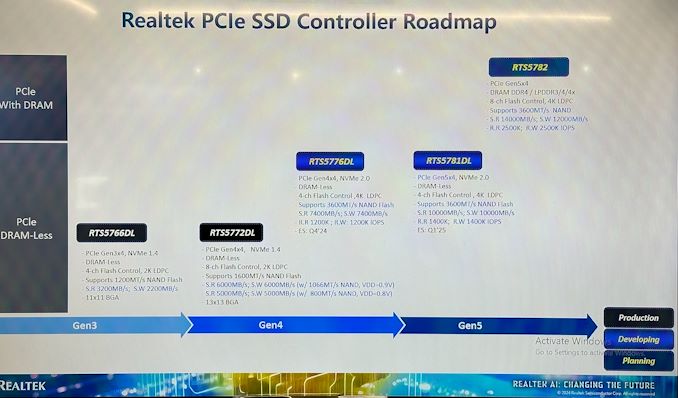
Finally, the pinnacle of Realtek's roadmap will be its RTS5782, which is the company's first high-end SSD controller. Besides including support for on-drive DRAM (DDR4/LPDDR4X) for higher performance, the back-end of the RTS5782 will feature an eight NAND channel design that supports transfer rates up to 3600 MT/second. Drives built with the controller are expected to be able to sustain 14GB/second sequential read rates and 12GB/second sequential writes, while the 4K random IOPS performance jumps to 2.5 million 4K read and write IOPS.
Unfortunately, the RTS5782 is also the farthest out of the three controllers, as it's still in the planning stages at Realtek. Consequently, for the moment the company isn't offering any guidance on when the new controller will be ready. No doubt the company will have more to show off next year for Computex 2025.
Noctua Shows Off Thermosiphon Based CPU Cooler Prototype At Computex 2024
Published: Jun 13nd 2024 10:30am on AnandTech
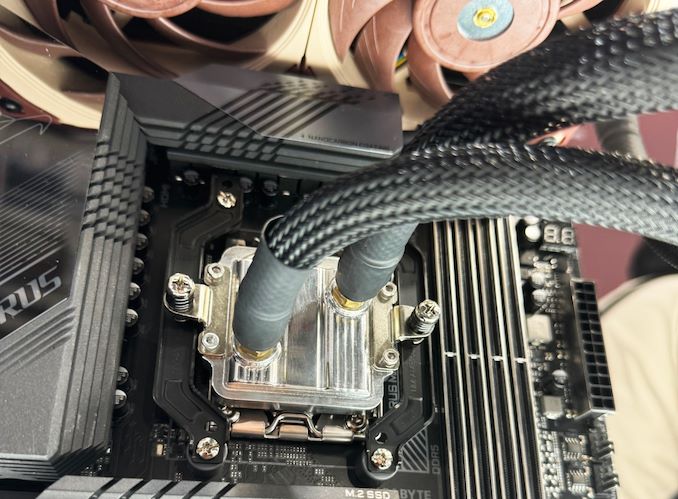
Many companies showed off a range of concept designs during Computex 2024, but perhaps Noctua had one of the coolest. Noctua, primarily known for its air coolers, had a pumpless prototype that showcased Thermisiphon cooling. It looks like a conventional AIO cooler on the surface but is much more efficient, cooler, and quieter than traditional water coolers.
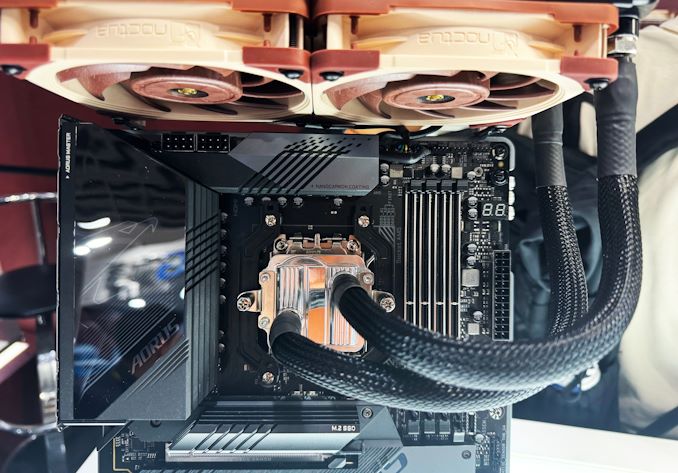
Touching quickly on Thermosiphon cooling, it uses the natural laws of thermodynamics to use heat (the CPU) as a source to turn the liquid to the top, evaporating through the system. This evaporated liquid rises and is pushed into the condenser (radiator), which, in the case of Noctua's cooler, is cooled by fans and turned back into liquid, which then flows back toward the CPU. Not only does Theromsiphon technology use gravity to help aid the flow of liquid, but it is also a highly efficient way of distributing heat as vaporization can absorb heat better, and it doesn't feature any moving parts in the mechanism, aside from the fans, of course.
As with traditional AIO CPU coolers, Noctua's Thermosiphon design has a 240mm radiator with a pair of 120cm Noctua fans, which cools the vapor down and sends it back to the evaporator. While this isn't a new concept and vapor chamber cooling has been used for many years in CPUs and even laptop coolers, Thermosiphon is certainly a technology Noctua thinks it can leverage to ensure better cooling performance and robust reliability.
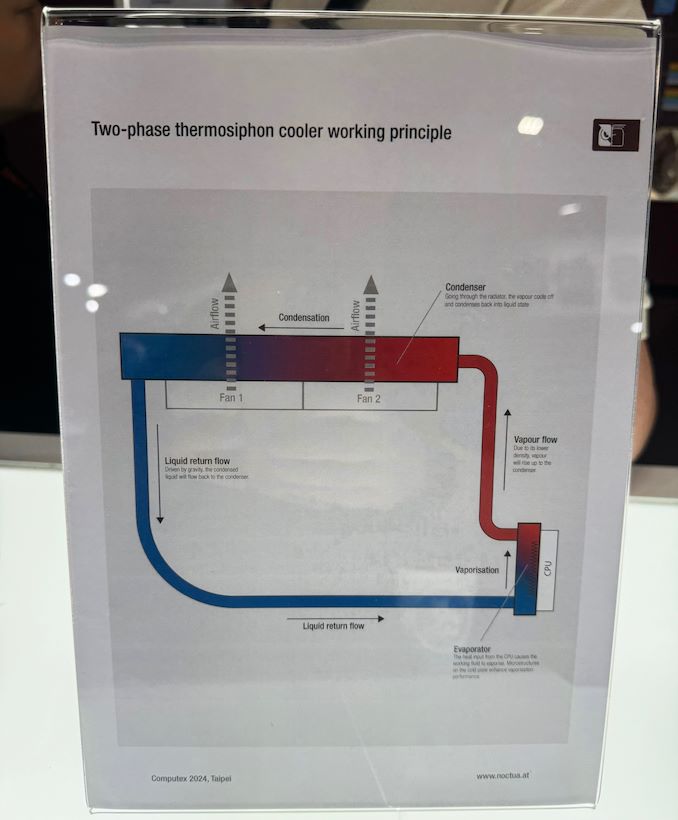
Speaking to Noctua at Computex 2024, they informed me of the benefits and pitfalls of the Thermosiphon technology. In terms of the pros, Thermosiphon cooling in itself has no moving parts, which not only improves reliability but also means there is less to go wrong. Another positive is that even the quietest AIO CPU coolers can be quite noisy, as the water pump that circulates the fluid can cause vibrations, which in turn makes noise. The biggest drawback of implementing Thermosiphon cooling for PCs is that conventional tubing can wear out over time. While adding metal tubing would last longer, it's not flexible, although Noctua said they have discussed this with system integrators.
Although Noctua's Thermosiphon is currently just a proof of concept and sis in the early development stage, there's no launch date or indication it will hit the market. It's an interesting design, and we hope it does eventually come to market.
The Qualcomm Snapdragon X Architecture Deep Dive: Getting To Know Oryon and Adreno X1
Published: Jun 13nd 2024 9:00am on AnandTech
The curtains are drawn and it’s almost showtime for Qualcomm and its Snapdragon X SoC team. After first detailing the SoC nearly 8 months ago at the company’s most recent Snapdragon Summit, and making numerous performance disclosures in the intervening months, the Snapdragon X Elite and Snapdragon X Plus launch is nearly upon us. The chips have already shipped to Qualcomm’s laptop partners, and the first laptops are set to ship next week.
In the last 8 months Qualcomm has made a lot of interesting claims for their high-performance Windows-on-Arm SoC – many of which will be put to the test in the coming weeks. But beyond all the performance claims and bluster amidst what is shaping up to be a highly competitive environment for PC CPUs, there’s an even more fundamental question about the Snapdragon X that we’ve been dying to get to: how does it work?
Ahead of next week’s launch, then, we’re finally getting the answer to that, as today Qualcomm is releasing their long-awaited architectural disclosure on the Snapdragon X SoC. This includes not only their new, custom Arm v8 “Oryon” CPU core, but also technical disclosures on their Adreno GPU, and the Hexagon NPU that backs their heavily-promoted AI capabilities. The company has made it clear in the past that the Snapdragon X is a serious, top-priority effort for the company – that they’re not just slapping together a Windows SoC from their existing IP blocks and calling it a day – so there’s a great deal of novel technology within the SoC.
And while we’re excited to look at it all, we’ll also be the first to admit that we’re the most excited to finally get to take a deep dive on Oryon, Qualcomm’s custom-built Arm CPU cores. The first new high-performance CPU design created from scratch in the last several years, the significance of Oryon cannot be overstated. Besides providing the basis of a new generation of Windows-on-Arm SoCs that Qualcomm hopes will vault them into contention in the Windows PC marketplace, Oryon will also be the basis of Qualcomm’s traditional Snapdragon mobile handset and tablet SoCs going forward.
So a great deal of the company’s hardware over the next few years is riding on this CPU architecture – and if all goes according to plan, there will be many more generations of Oryon to follow. One way or another, it’s going to set Qualcomm apart from its competitors in both the PC and mobile spaces, as it means Qualcomm is moving on from Arm’s reference designs, which by their very nature are accessible Qualcomm’s competition as well.
So without further ado, let’s dive in to Qualcomm’s Snapdragon X SoC architecture.
Samsung Foundry Unveils Updated Roadmap: BSPDN and 2nm Evolution Through 2027
Published: Jun 13nd 2024 7:00am on AnandTech
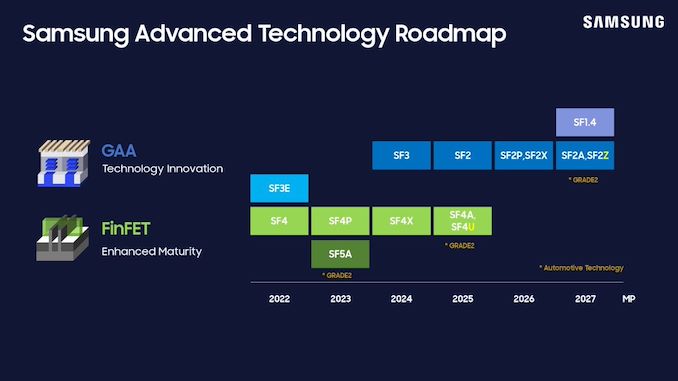
Samsung this week has unveiled its latest process technologies roadmap at the company's Samsung Foundry Forum (SFF) U.S. The new plan covers the evolution of Samsung's 2nm-class production nodes through 2027, including a process technology with a backside power delivery, re-emphasizing plans to bring out a 1.4nm-class node in 2027, and the introduction of a 'high value' 4nm-class manufacturing tech.
Samsung Foundry's key announcements for today are clearly focused on the its 2nm-class process technologies, which are set to enter production in 2025 and will span to 2027, when the company's 1.4-nm class production node is set to enter the scene. Samsung is also adding (or rather, renaming) another 2nm-class node to their roadmap with SF2, which was previously disclosed by Samsung as SF3P and aimed at high-performance devices.
"We have refined and improved the SF3P, resulting in what we now refer to as SF2," a Samsung spokesperson told AnandTech. "This enhanced node incorporates various process design improvements, delivering notable power, performance, and area (PPA) benefits."
Samsung Foundry for Leading-Edge Nodes Announced on June 12, 2024 Compiled by AnandTech HVM Start 2023 2024 2025 2026 2027 2027 Process SF3E SF3 SF2 (aka SF3P) SF2P/SF2X SF2Z SF1.4 FET GAAFET Power Delivery Frontside Backside (BSPDN) ? EUV 0.33 NA EUV ? ? ? ?This is another example of a rebranding of leading-edge fabrication nodes in the recent years by a major chipmaker. Samsung Foundry is not disclosing any specific PPA improvements SF3P has over SF2, and for now is only stating in high-level terms that it will be a better-performing node than the planned SF3P.
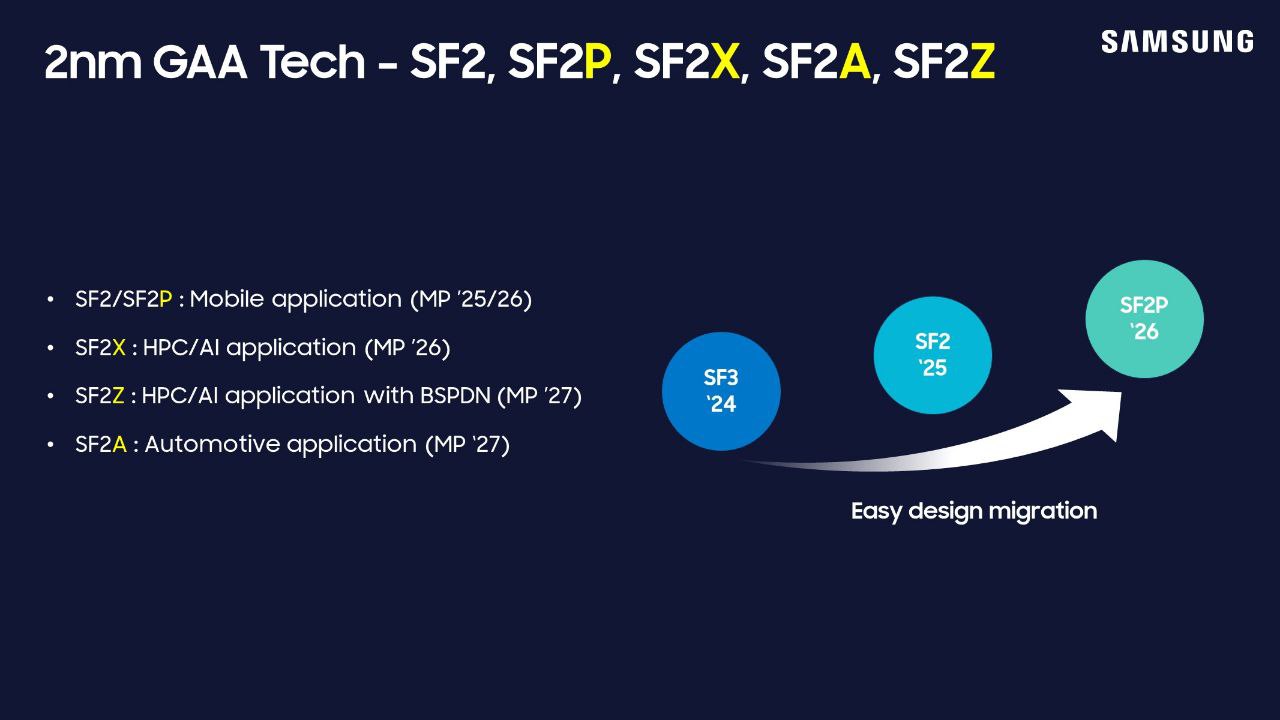
Meanwhile, this week's announcement also includes new information on Samsung's next batch of process nodes, which are planned for 2026 and 2027. In 2026 Samsung will have SF2P, a further refinement of SF2 which incorporates 'faster' yet less dense transistors. That will be followed up in 2027 with SF2Z, which adds backside power delivery to the mix for better and higher quality power delivery. In particular, Samsung is targetting voltate drop (aka IR drop) here, which is an ongoing concern in chip design.
Finally, SF1.4, a 1.4nm-class node, is on track for 2027 as well. Interestingly, however, it looks like it does not feature a backside power delivery. Which, per current roadmaps, would have Samsung as the only foundry not using BSPDN for their first 1.4nm/14Å-class node.
"We have optimized BSPDN and incorporated it for the first time in the SF2Z node we announced today," the spokesperson told us. "We will continue to refine this technology and apply it to future nodes, but we don't have a specific timeline to share at this time."
Chip Fab Roadmaps for Leading-Edge Nodes Data announced during conference calls, events, press briefings and press releases. Compiled by AnandTech HVM Start 2023 2024 2025 2026 2027 Intel Process Intel 3 Intel 20A Intel 18A Intel 14A Intel 10A FET FinFET RibbonFET (GAAFET) Power Frontside PowerVia (BSPDN) EUV 0.33 NA EUV 0.55 NA EUV + DSA Samsung Process SF3E SF3 SF2 SF2P/SF2X SF2Z/SF1.4 FET GAAFET Power Frontside Backside/? EUV 0.33 NA EUV ? ? ? TSMC Process N3E/N3P N3S/N3X N2 A16 A14 (?) FET FinFET GAAFET Power Frontside Super Power Rail (BSPDN) EUV 0.33 NA EUV ?When compared to other contract fabs, Samsung's roadmap is now roughly in line with the rest in regards to 'nanometer' designations. Though absent further technical disclosures from Samsung, it remains unclear what the actual benefits will be for each node and how they compare to their predecessors, let alone how they'll compare to Intel Foundry and TSMC.
Report: MediaTek Working on Arm-Based Processor for Windows PCs
Published: Jun 12nd 2024 5:00am on AnandTech
As Qualcomm's exclusivity for Arm-powered processors for Windows PCs is reportedly coming to its end, other chipmakers are getting ready to offer their Arm-based system-on-chips for Windows computers. And, according to a new report from Reuters, MediaTek will be among the companies jumping into the Windows-on-Arm field, with plans to launch their first PC processor next year.
MediaTek's system-on-chip for Windows PCs will rely on Arm's 'ready-made designs,' according to Reuters. Which in turn hints that MediaTek would be using Arm's compute sub-system (CSS) for client PCs, a building block designed to significantly speed up development of SoCs.
With the vauge nature of the Reuters report, however, which version of Arm's IP MediaTek might be using remains unclear, and the answer to that will largely hinge on timing. Arm refreshes its client cores and IP offerings yearly – typically announcing them to the public in May – with finished chips rolling out as early as later in the year. So depending on whether MediaTek is targeting a mid-year or late-year launch, the company has a large enough window to potentially use either the current 2024 client designs, or next year's 2025 designs.
For reference, Arm's 2024 CSS for client systems is quite powerful on its own. It includes two ultra-high-performance Arm Cortex-X925 cores (each with up to 3MB L2 cache and clock speeds over 3.60 GHz, supporting SVE and SVE2), four high-performance Cortex-A725 cores, two energy-efficient Cortex-A520 cores, and an Immortalis-G925 graphics processor. And, of course, MediaTek has the expertise to skip Arm's CSS and build their own bespoke designs as well, if that's what they'd prefer.
Overall, the latest client designs from Arm can accommodate up to 14 CPU cores – Arm intentionally leaves headroom for designs to be scaled-up for laptops – which would make for quite a formidable chip. But the PC SoC market has no shortage of capable contenders with their own designs; besides Qualcomm's Snapdragon X processors, MediaTek would also be going up against the latest designs from Intel and AMD. All of whom are planning to make big plays for the mobile PC market in the next several months. So MediaTek will need to make a serious effort if their effort to jump into the PC SoC market are to succeed.
Since 2016, Microsoft has partnered with Qualcomm to bring Arm's processor architecture, which is widely used in smartphones, to Windows PCs. Qualcomm has an exclusive agreement to supply these chips for the next several months (the exact timing remains unclear), after which other designers like MediaTek can enter the market. Qualcomm, for its part, has benefited greatly from collaborating with Microsoft, so it will be interesting to see if Microsoft extends a similar hand out to other Arm chip makers.
Ultimately, the market for Arm PC SoCs has the potential to get crowded quickly. According to previous reports from Reuters, both AMD and NVIDIA are also developing Arm-based chips for Windows. So if all of those projects come to fruition, there could potentially be several Arm SoCs available to PC manufacturers around the same time. All of which would be a massive change from the past 20 years of the PC, where Intel and AMD have been the entire market.
Both MediaTek and Microsoft have declined to comment on the ongoing developments, the news agency states.
ASMedia Preps USB4 v2 Controller and PHY
Published: Jun 12nd 2024 8:00am on AnandTech
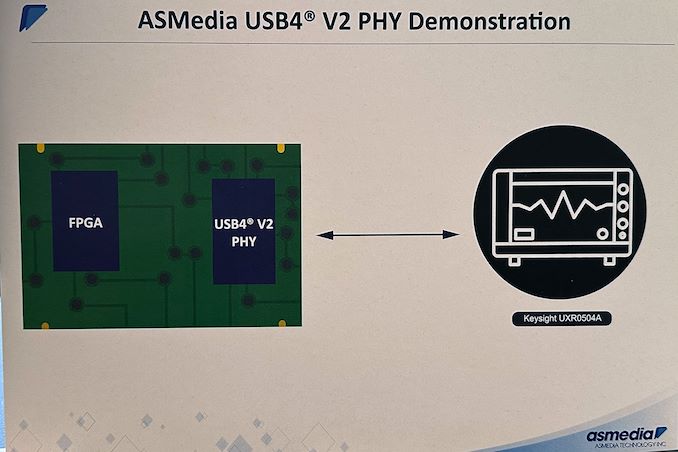
The USB Implementers Forum (USB-IF) introduced USB4 version 2.0 in fall 2022, and it expects systems and devices with the tech to emerge later this year and into next year. These upcoming products will largely rely on Intel's Barlow Ridge controller, a full-featured Thunderbolt 5 controller that goes above and beond the baseline USB4 v2 spec. And though extremely capable, Intel's Thunderbolt controllers are also quite expensive, and Barlow Ridge isn't expected to be any different. Fortunately, for system and device vendors that just need a basic USB4 v2 solution, ASMedia is also working on its own USB4 v2 controller.
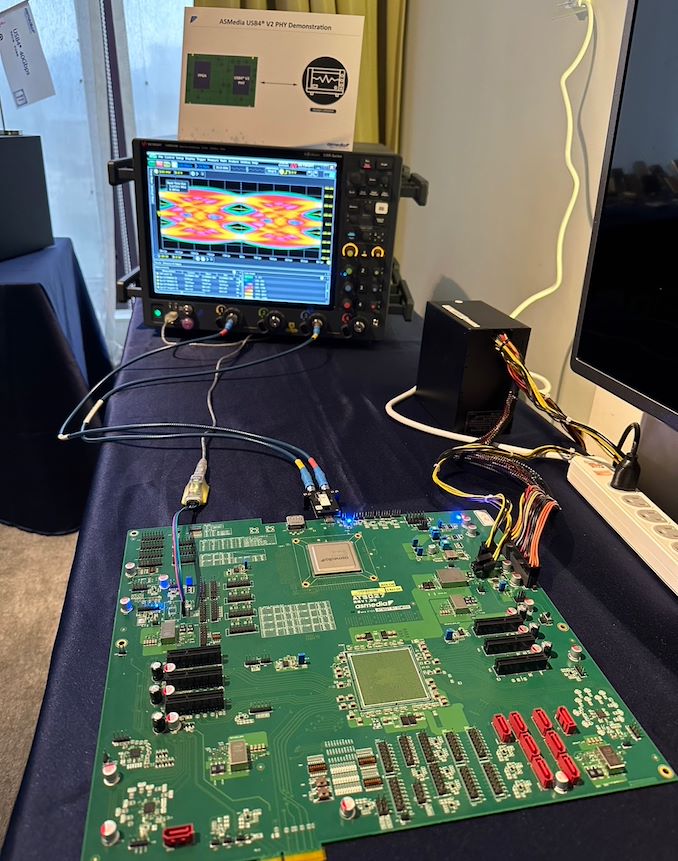
At Computex 2024, ASMedia demonstrated a prototype of its upcoming USB4 v2 physical interface (PHY), which will support USB4 v2's new Gen 4 (160Gbps) data rates and the associated PAM-3 signal encoding. The prototype was implemented using an FPGA, as the company yet has to tape out the completed controller.
Ultimately, the purpose of showing off a FPGA-based PHY at Computex was to allow ASMedia to demonstrate their current PHY design. With the shift to PAM-3 encoding for USB4 v2, ASMedia (and the rest of the USB ecosystem) must develop significantly more complex controllers – and there's no part of that more critical than a solid and reliable PHY design.
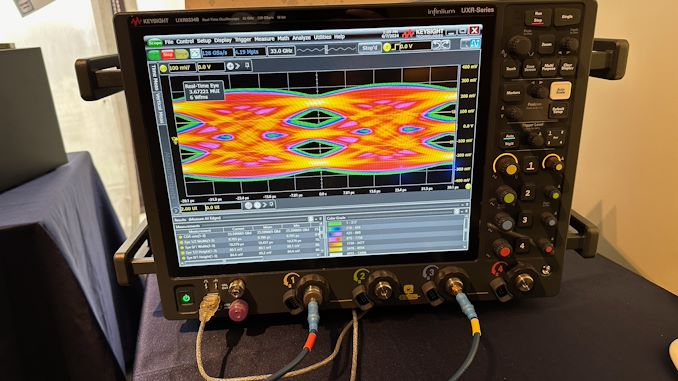
As part of their demonstration, ASMedia had a classic eye diagram display. The eye diagram demoed has a clear opening in the center, which is indicative of good signal integrity, as the larger the eye opening, the less distortion and noise in the signal. The horizontal width of the eye opening represents the time window in which the signal can be sampled correctly, so the relatively narrow horizontal spread of the eye opening suggests that there is minimal jitter, meaning the signal transitions are consistent and predictable. Finally, the vertical height of the eye opening indicates the signal amplitude and the rather tall eye opening suggests a higher signal-to-noise ratio (SNR), meaning that the signal is strong compared to any noise present.
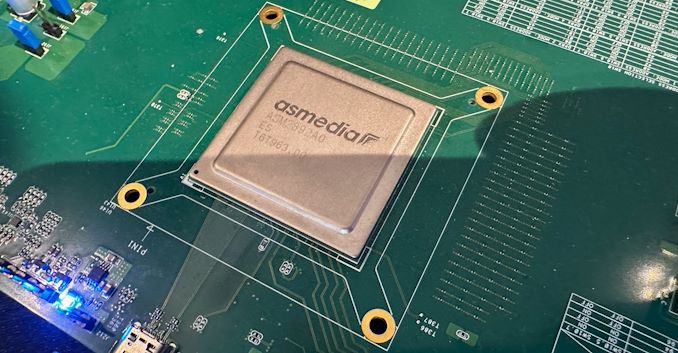
ASMedia itself is one of the major suppliers for discrete USB controllers, so the availability of ASMedia's USB4 v2 chip is crucial for adoption of the standard in general. While Intel will spearhead the industry with their Barlow Ridge Thunderbolt 5/USB4 v2 controller, ASMedia's controller is poised to end up in a far larger range of devices. So the importance of the company's USB4 v2 PHY demo is hard to overstate.
Demos aside, ASMedia is hoping to tape the chip out soon. If all goes well, the company expects their first USB4 v2 controllers to hit the market some time in the second half of 2025.
Qualcomm: Some Snapdragon X Elite Laptops Will Come with 5G Modems
Published: Jun 11nd 2024 6:00am on AnandTech

One of Qualcomm's indisputable strengths are its 5G modems – something which even Apple has yet to successfully ween itself from. And while Qualcomm is not integrating a modem into its first-generation Oryon-based Snapdragon X chips, the company is still looking to leverage that technology advantage via discrete modems that can be installed in Snapdragon X laptops.
To date, Qualcomm has won 23 laptop designs with its Snapdragon X Elite SoCs, and all of the leading PC vendors have introduced systems based on Qualcomm's Snapdragon X Elite processors. However, only some of them will be equipped with modems, the company detailed at Computex 2024.
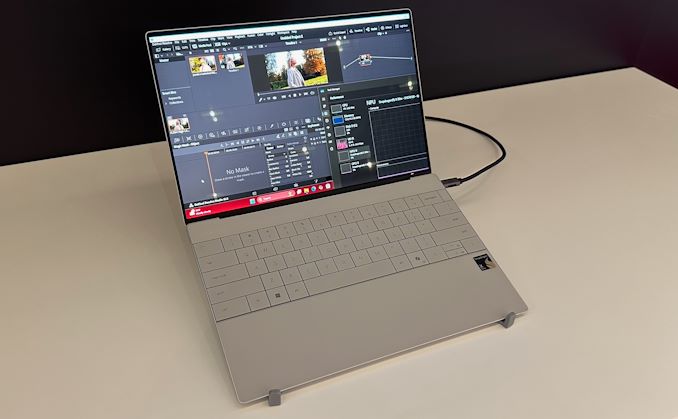
While the technical rationale for this is very straightforward (not every vendor wants to buy and dedicate the space to modems), it's still a bit of a surprise in as much as Qualcomm has traditionally heavily pushed laptop vendors to include their modems. But as the Snapdragon X has entered the picture, the joint Qualcomm/Microsoft always connected PC (ACPC) initiative is taking a back seat – meaning modems are no longer being pushed nearly as hard. In its place, the two companies have pivoted hard to equipping mainstream systems with the hardware needed for local AI processing (i.e. NPUs), and with it, Microsoft's Copilot+ PC branding.
Laptop manufacturers, in the meantime, are breathing a sigh of relief, as this switch to emphasizing AI comes at a much lower hardware cost, since vendors don't need to buy additional discrete hardware. Qualcomm for its part has never fully disclosed the full cost of including a Snapdragon modem with a laptop, but the total cost adds up quickly. Besides buying a discrete modem, device manufacturers also need to buy and integrate a 5G-capable radio frequency front end module (RF FEM), as well as the all-important antenna. And mmWave support of any kind can add another wrinkle, as multiple antennas at different orientations are needed to get the best results.
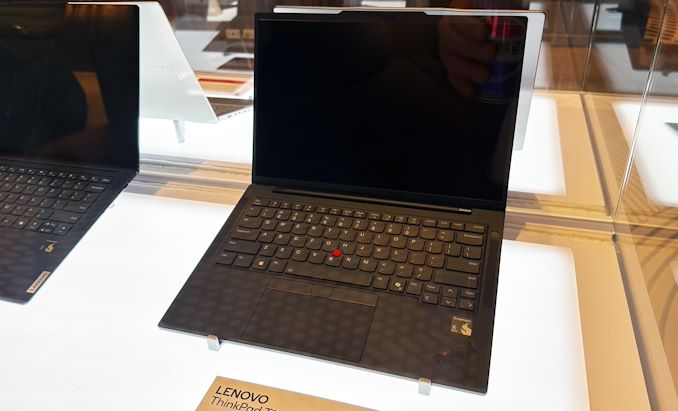
And while not said out-loud, Qualcomm's premium positioning strategy for 8cx-based laptops has not paid significant dividends. Snapdragon X laptops are being priced much more competitively, as Qualcomm is aiming to capture a meaningful share of the PC market – and high-cost features like modems would drive up the final price tag.
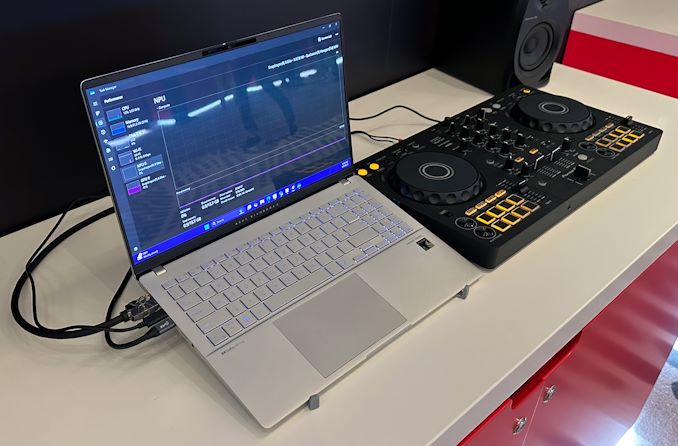
Still, virtually all Qualcomm representatives I talked to at Computex were happy to argue that an integrated modem is a huge benefit for their PCs, as they can get fast connectivity almost everywhere in the world instantly and not depend on Wi-Fi or even their smartphones. So the dream of widespread 5G-capable laptops is not dead at Qualcomm; it may just be delayed. In the meantime, for laptop buyers that do need or want a 5G modem, there will still be at least a few premium laptop models on store shelves with the necessary hardware.
No, It Does Not Fly: Corsair Demos '9000D Airflow' PC Case with 24 Fans
Published: Jun 11nd 2024 1:00am on AnandTech
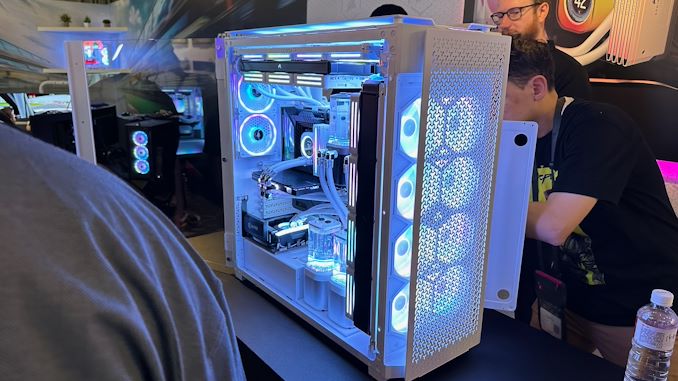
Trade shows like Computex always bring out their fair share of oddities, and this year was no exception, with one of the highlights being a Corsair PC case with no fewer than 24 fans.
As one of a handful of companies offering really big desktop PC cases, Corsair was demonstrating its new creature: the 9000D Airflow. At 90 liters in volume – which is twice the size of regular PCs and 1.5x the volume of a typical car gas tank – the colossal case is bigger than ever. It's so big, in fact, that it can house two systems: a full-size ATX (or smaller) system, as well as a separate Mini-ITX system.
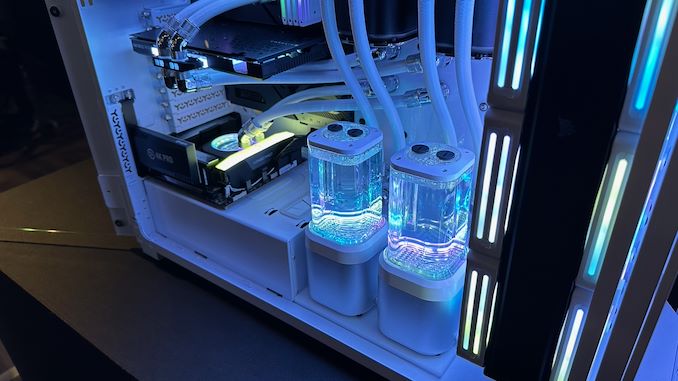
Gallery: No, It Does Not Fly: Corsair Has a PC Chassis with 24 Fans


The most eye-catching aspect of this PC case (besides its large size, of course) is that it can house as many as 22 fans in addition to two liquid cooling systems. As the name of the 9000D Airflow implies, all of those fans are meant to create as much airflow as possible. And yet, because there are so many fans inside, they do not have to run at a high RPM to move the requisite amount of air, so the 9000D Airflow is quieter than its size otherwise lets on.
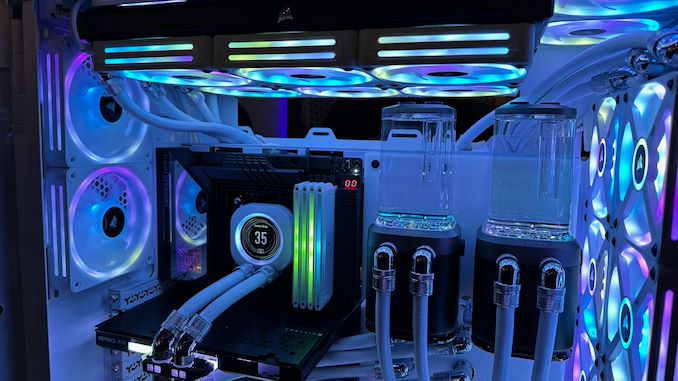
To simplify installation of all these fans, the chassis consists of adjustable mounting points on a sliding rail, making the case versatile for any build requirements. The 9000D includes two InfiniRail systems, one at the top (holding six fans) and one at the front, each capable of holding up to eight 120mm fans. Adding fans on the sides and rear increases the total to 24. For those using 140mm or 200mm fans, the InfiniRails can be adjusted by unscrewing and repositioning them based on marked guidelines, allowing for a customized setup despite fitting fewer larger fans. The flexibility of the InfiniRail system enables unique fan placement, enabling the freedom to tailor the cooling configuration to specific needs.
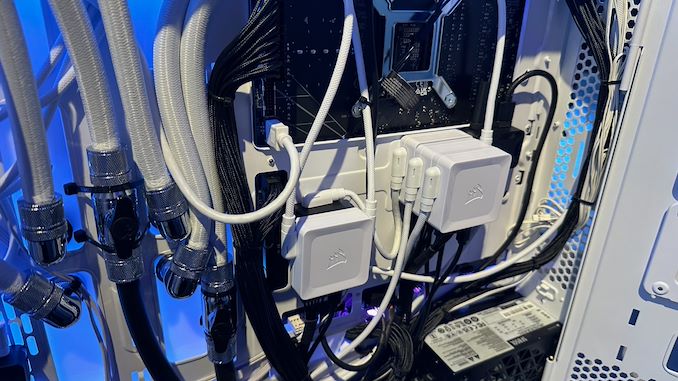
The case design also includes 30mm of clearance behind the motherboard for efficient cable management, making it well-suited for creating clean, organized, and powerful builds.
Besides its may fans, the 9000D Airflow also offers 11 drive bays, plenty of front I/O ports (four USB Type-A, two USB Type-C, audio connectors) with RGB lighting controlled through the iCue Link system. The spacious design allows for comprehensive component compatibility and expansion.
Corsair's Airflow 9000D will be available later this year.
Cheaper PCIe 5.0 x4 SSDs Incoming: Silicon Power Demos Phison E31T-Based SSD
Published: Jun 11nd 2024 10:00am on AnandTech
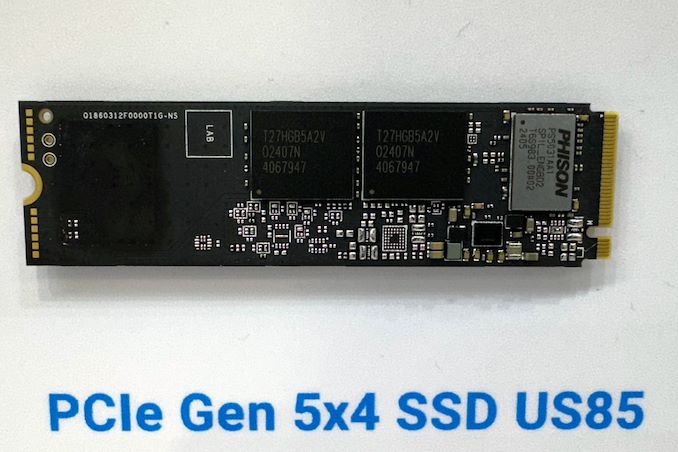
Although consumer SSDs based on Phison's PS5026-E26 controller have been on the market for almost a year and a half now, the class-leading drives still carry a distinct price premium, and to some degree that's because it's still one of the only options for a PCIe 5.0 SSD. But it looks like the situation is going to change in the coming quarters, as SSDs based on Phison's PS5031-E31T controller are incoming, with at least one Phison customer demoing an E31T drive on the Computex show floor.
Phison's PS5031-E31T controller uses two Arm Cortex-R5 cores accelerated by the Andes N25 CoXProcessor, just like its bigger brother Phison PS5026-E26. But this is where their major hardware similarities seem to end. The new E31T controller is a DRAM-less controller with four NAND channels (16 CE targets) that is produced on one of TSMC's 7nm processes, whereas the E26 is an eight-channel controller made on TSMC's 12nm production node.
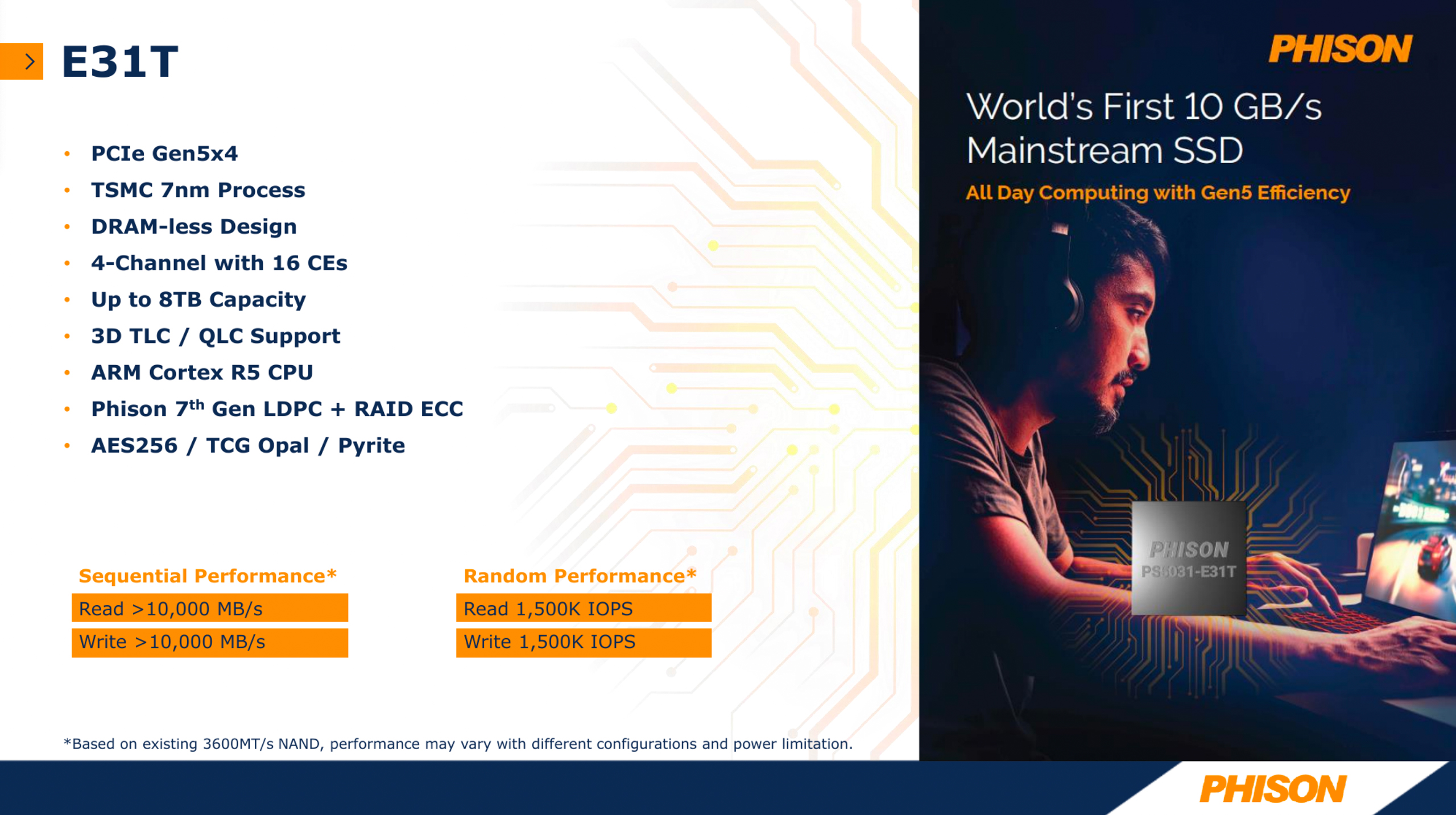
Besides cutting down on memory channels and the use of DRAM to drive down costs, the E31T also picks up a couple of new tricks by virtue of being nearly two years newer. In particular, the E31T sports Phison's 7th Generation LDPC error correction technology, as opposed to the E25's 5th-gen LDPC
Phison NVMe SSD Controller Comparison E31T E27T E21T E26 E18 Market Segment Mainstream Consumer High-End Consumer Manufacturing Process 7nm 12nm 12nm 12nm 12nm CPU Cores 2x Cortex R5 1x Cortex R5 1x Cortex R5 2x Cortex R5 3x Cortex R5 Error Correction 7th Gen LDPC 5th Gen LDPC 4th Gen LDPC 5th Gen LDPC 4th Gen LDPC DRAM No No No DDR4, LPDDR4 DDR4 Host Interface PCIe 5.0 x4 PCIe 4.0 x4 PCIe 4.0 x4 PCIe 5.0 x4 PCIe 4.0 x4 NVMe Version NVMe 2.0 NVMe 2.0 NVMe 1.4 NVMe 2.0 NVMe 1.4 NAND Channels, Interface Speed 4 ch, 3600 MT/s 4 ch, 3600 MT/s 4 ch, 1600 MT/s 8 ch, 2400 MT/s 8 ch, 1600 MT/s Max Capacity 8 TB 8 TB 4 TB 8 TB 8 TB Sequential Read 10.8 GB/s 7.4 GB/s 5.0 GB/s 14 GB/s 7.4 GB/s Sequential Write 10.8 GB/s 6.7 GB/s 4.5 GB/s 11.8 GB/s 7.0 GB/s 4KB Random Read IOPS 1500k 1200k 780k 1500k 1000k 4KB Random Write IOPS 1500k 1200k 800k 2000k 1000kPhison itself calls its E31T platform 'the first mainstream 10 GB/s platform,' which pretty much gives a performance indicator for some of the upcoming inexpensive PCIe Gen5 SSDs. As for random performance, we are talking about 1.5M IOPS per second, which is in line with performance offered by some of enterprise-grade PCIe Gen4 SSDs.
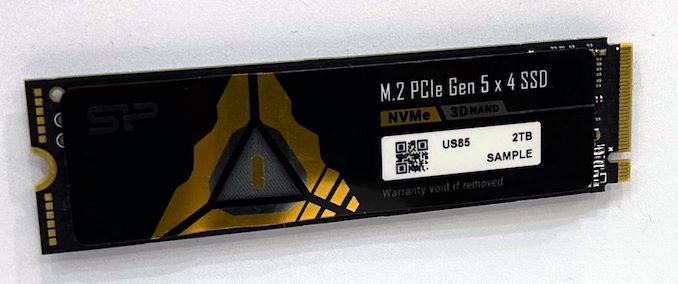
Meanwhile, a Silicon Power ad at Computex indicates that that the company at least hopes to get to 12 GB/sec with its "US85" drive. Which at 4 NAND channels would require pairing up the controller with cutting-edge 3200 MT/sec NAND. It's a bit of an odd pairing given the mainstream, cost-conscious status of the E31T controller, but then the savings on the controller supporting DRAM can be invested back into the NAND on the drive itself. And more importantly, with 12 GB/sec reads and writes, Silicon Power's US85 SSD will be able to compete against earlier E26-based drives that are still being sold on the market, which brings this product to a whole new level. Though Silicon Power will have to be able to procure enough fast 3D NAND to meet demand.
Both Phison and Silicon Power expect E31T to start shipping in Q4, so by the start of next year, mainstream SSDs should be receiving a nice speed boost.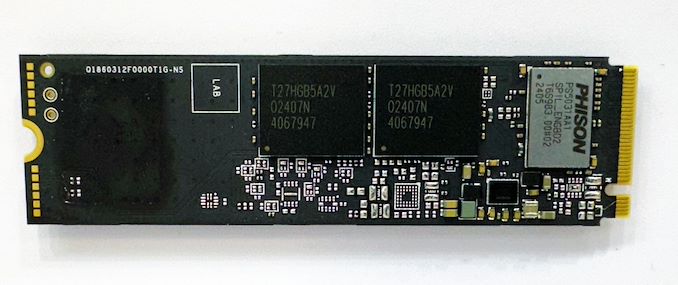
SK hynix: GDDR7 Mass Production To Start in Q1'2025
Published: Jun 11nd 2024 8:00am on AnandTech
Being a major JEDEC memory standard, GDDR7 is slated to be produced by all three of the Big Three memory manufacturers. But it seems that not all three vendors will be kicking off mass production at the same time.
SK hynix was at this year's Computex trade show, showing off their full lineup of memory technologies – including, of course, GDDR7. SK hynix is the last of the major memory vendor's we've seen promoting their memory, and fittingly, they seem to be the last in terms of their mass production schedule. According to company representatives at the show, the firm will not kick off mass production of their GDDR7 chips until the first quarter of 2025.
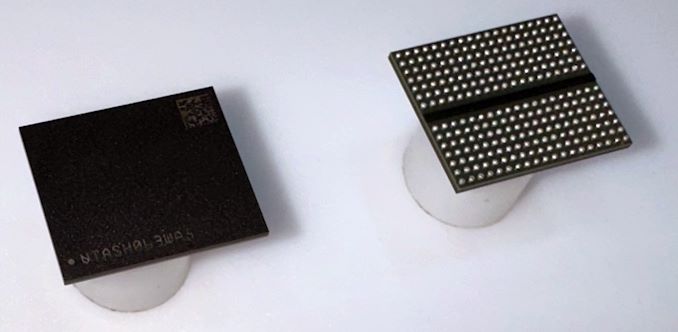
Comparatively, the company's cross-town rival, Samsung, is already sampling memory with the goal of getting it out the door in 2024. And Micron has been rather gung ho about not only starting mass production this year, but starting it early enough that at least some of their customers will be able to ship finished products this year. So if these schedules hold, then SK hynix would seem to be a quarter or so out from the other major memory vendors.
That said, it bears mentioning that with industry-standard memory technologies, mass production at one vendor does not indicate that another is late; it is just indicating that someone was first to validate with a partner and that partner plans to ship its product in 2024. And while mass production remains another 7+ months out, SK hynix does have sample chips for its partners to test right now, and the chips have been demonstrated at Computex.
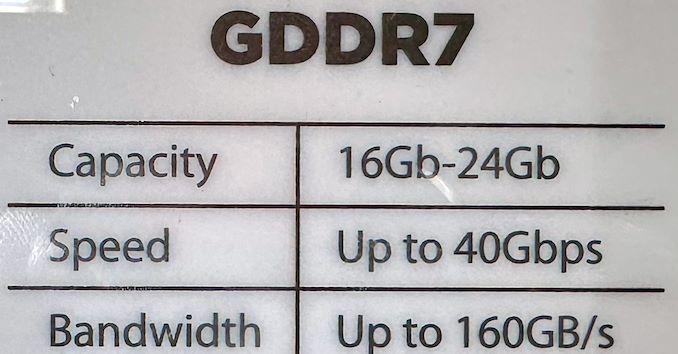
As far as SK hynix's floor booth at Computex 2024 is concerned, the company had GDDR7 chips on display along with a table essentially summarizing the company's roadmap. For now, SK hynix is planning on both 16Gbit and 24Gbit chips, with data transfer rates of up to 40 GT/s. Though when SK hynix intends to launch their higher-end configurations remains to be seen. Both of the company's rivals are starting out with 16Gbit chips running at 32 GT/sec, so being the first to get a faster/larger chip out would be a feather in SK hynix's cap.