End of the Road: An AnandTech Farewell
Published: Aug 30nd 2024 8:00am on AnandTech
It is with great sadness that I find myself penning the hardest news post I’ve ever needed to write here at AnandTech. After over 27 years of covering the wide – and wild – word of computing hardware, today is AnandTech’s final day of publication.
For better or worse, we’ve reached the end of a long journey – one that started with a review of an AMD processor, and has ended with the review of an AMD processor. It’s fittingly poetic, but it is also a testament to the fact that we’ve spent the last 27 years doing what we love, covering the chips that are the lifeblood of the computing industry.
A lot of things have changed in the last quarter-century – in 1997 NVIDIA had yet to even coin the term “GPU” – and we’ve been fortunate to watch the world of hardware continue to evolve over the time period. We’ve gone from boxy desktop computers and laptops that today we’d charitably classify as portable desktops, to pocket computers where even the cheapest budget device puts the fastest PC of 1997 to shame.
The years have also brought some monumental changes to the world of publishing. AnandTech was hardly the first hardware enthusiast website, nor will we be the last. But we were fortunate to thrive in the past couple of decades, when so many of our peers did not, thanks to a combination of hard work, strategic investments in people and products, even more hard work, and the support of our many friends, colleagues, and readers.
Still, few things last forever, and the market for written tech journalism is not what it once was – nor will it ever be again. So, the time has come for AnandTech to wrap up its work, and let the next generation of tech journalists take their place within the zeitgeist.
It has been my immense privilege to write for AnandTech for the past 19 years – and to manage it as its editor-in-chief for the past decade. And while I carry more than a bit of remorse in being AnandTech’s final boss, I can at least take pride in everything we’ve accomplished over the years, whether it’s lauding some legendary products, writing technology primers that still remain relevant today, or watching new stars rise in expected places. There is still more that I had wanted AnandTech to do, but after 21,500 articles, this was a good start.
And while the AnandTech staff is riding off into the sunset, I am happy to report that the site itself won’t be going anywhere for a while. Our publisher, Future PLC, will be keeping the AnandTech website and its many articles live indefinitely. So that all of the content we’ve created over the years remains accessible and citable. Even without new articles to add to the collection, I expect that many of the things we’ve written over the past couple of decades will remain relevant for years to come – and remain accessible just as long.
The AnandTech Forums will also continue to be operated by Future’s community team and our dedicated troop of moderators. With forum threads going back to 1999 (and some active members just as long), the forums have a history almost as long and as storied as AnandTech itself (wounded monitor children, anyone?). So even when AnandTech is no longer publishing articles, we’ll still have a place for everyone to talk about the latest in technology – and have those discussions last longer than 48 hours.
Finally, for everyone who still needs their technical writing fix, our formidable opposition of the last 27 years and fellow Future brand, Tom’s Hardware, is continuing to cover the world of technology. There are a couple of familiar AnandTech faces already over there providing their accumulated expertise, and the site will continue doing its best to provide a written take on technology news.
So Many Thank YousAs I look back on everything AnandTech has accomplished over the past 27 years, there are more than a few people, groups, and companies that I would like to thank on behalf of both myself and AnandTech as a whole.
First and foremost, I cannot thank enough all the editors who have worked for AnandTech over the years. There are far more of you than I can ever name, but AnandTech’s editors have been the lifeblood of the site, bringing over their expertise and passion to craft the kind of deep, investigative articles that AnandTech is best known for. These are the finest people I’ve ever had the opportunity to work with, and it shouldn’t come as any surprise that these people have become even bigger successes in their respective fields. Whether it’s hardware and software development, consulting and business analysis, or even launching rockets into space, they’ve all been rock stars whom I’ve been fortunate to work with over the past couple of decades.
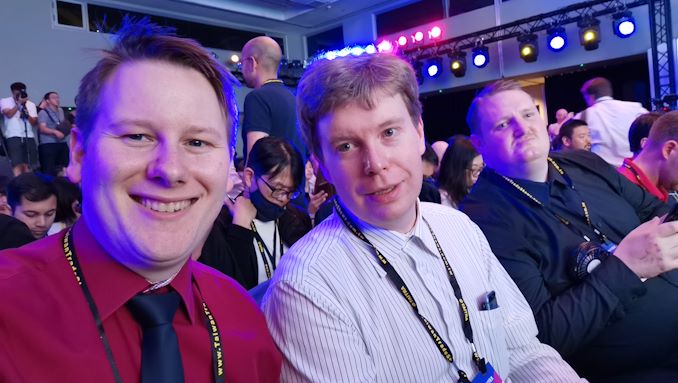 Ian Cutress, Anton Shilov, and Gavin Bonshor at Computex 2019
And a special shout out to the final class of AnandTech editors, who have been with us until the end, providing the final articles that grace this site. Gavin Bonshor, Ganesh TS, E. Fylladitakis, and Anton Shilov have all gone above and beyond to meet impossible deadlines and go half-way around the world to report on the latest in technology.
Of course, none of this would have been possible without the man himself, Anand Lal Shimpi, who started this site out of his bedroom 27 years ago. While Anand retired from the world of tech journalism a decade ago, the standard he set for quality and the lessons he taught all of us have continued to resonate within AnandTech to this very day. And while it would be tautological to say that there would be no AnandTech without Anand, it’s none the less true – the mark on the tech publishing industry that we’ve been able to make all started with him.
 MWC 2014: Ian Cutress, Anand Lal Shimpi, Joshua Ho
I also want to thank the many, many hardware and software companies we’ve worked with over the years. More than just providing us review samples and technical support, we’ve been given unique access to some of the greatest engineers in the industry. People who have built some of the most complex chips ever made, and casually forgotten more about the subject than we as tech journalists will ever know. So being able to ask those minds stupid questions, and seeing the gears turn in their heads as they explain their ideas, innovations, and thought processes has been nothing short of an incredible learning experience. We haven’t always (or even often) seen eye-to-eye on matters with all of the companies we've covered, but as the last 27 years have shown, sharing the amazing advancements behind the latest technologies has benefited everyone, consumers and companies alike.
Thank yous are also due to AnandTech’s publishers over the years – Future PLC, and Purch before them. AnandTech’s publishers have given us an incredible degree of latitude to do things the AnandTech way, even when it meant taking big risks or not following the latest trend. A more cynical and controlling publisher could have undoubtedly found ways to make more money from the AnandTech website, but the resulting content would not have been AnandTech. We’ve enjoyed complete editorial freedom up to our final day, and that’s not something so many other websites have had the luxury to experience. And for that I am thankful.
 CES 2016: Ian Cutress, Ganesh TS, Joshua Ho, Brett Howse, Brandon Chester, Billy Tallis
Finally, I cannot thank our many readers enough. Whether you’ve been following AnandTech since 1997 or you’ve just recently discovered us, everything we’ve published here we’ve done for you. To show you what amazing things were going on in the world of technology, the radical innovations driving the next generation of products, or a sober review that reminds us all that there’s (almost) no such thing as bad products, just bad pricing. Our readers have kept us on our toes, pushing us to do better, and holding us responsible when we’ve strayed from our responsibilities.
Ultimately, a website is only as influential as its readers, otherwise we would be screaming into the void that is the Internet. For all the credit we can claim as writers, all of that pales in comparison to our readers who have enjoyed our content, referenced it, and shared it with the world. So from the bottom of my heart, thank you for sticking with us for the past 27 years.
Continuing the Fight Against the Cable TV-ification of the WebFinally, I’d like to end this piece with a comment on the Cable TV-ification of the web. A core belief that Anand and I have held dear for years, and is still on our About page to this day, is AnandTech’s rebuke of sensationalism, link baiting, and the path to shallow 10-o'clock-news reporting. It has been our mission over the past 27 years to inform and educate our readers by providing high-quality content – and while we’re no longer going to be able to fulfill that role, the need for quality, in-depth reporting has not changed. If anything, the need has increased as social media and changing advertising landscapes have made shallow, sensationalistic reporting all the more lucrative.
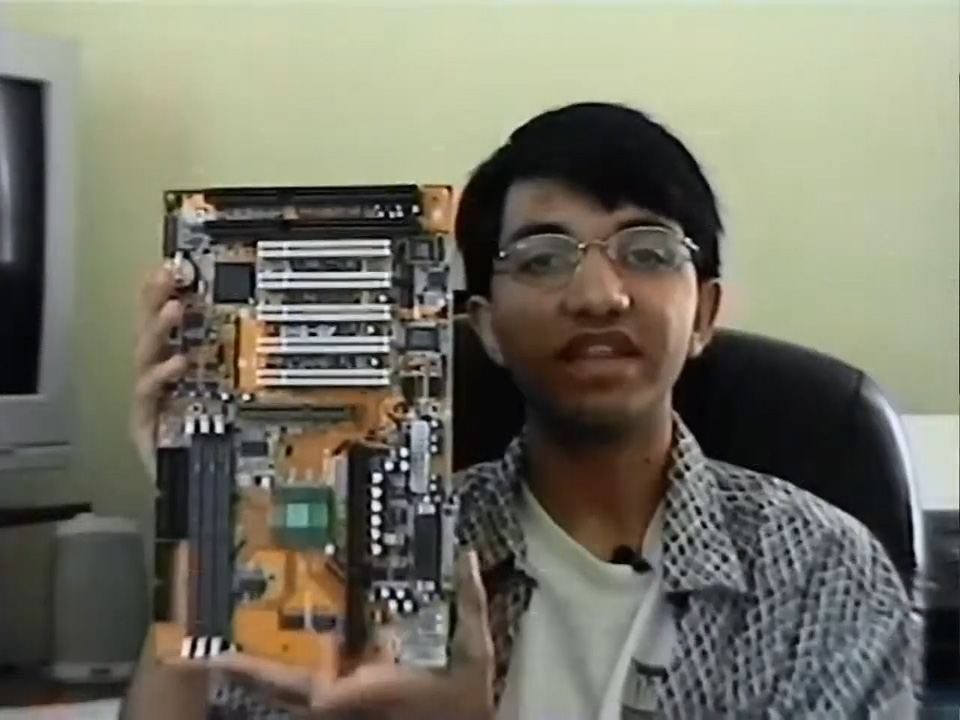 Speaking of TV: Anand Hosting The AGN Hardware Show (June 1998)
For all the tech journalists out there right now – or tech journalists to be – I implore you to remain true to yourself, and to your readers' needs. In-depth reporting isn’t always as sexy or as exciting as other avenues, but now, more than ever, it’s necessary to counter sensationalism and cynicism with high-quality reporting and testing that is used to support thoughtful conclusions. To quote Anand: “I don't believe the web needs to be academic reporting or sensationalist garbage - as long as there's a balance, I'm happy.”
Signing Off One Last TimeWrapping things up, it has been my privilege over the last 19 years to write for one of the most impactful tech news websites that has ever existed. And while I’m heartbroken that we’re at the end of AnandTech’s 27-year journey, I can take solace in everything we’ve been able to accomplish over the years. All of which has been made possible thanks to our industry partners and our awesome readers.
On a personal note, this has been my dream job; to say I’ve been fortunate would be an understatement. And while I’ll no longer be the editor-in-chief of AnandTech, I’m far from being done with technology as a whole. I’ll still be around on Twitter/X, and we’ll see where my own journey takes me next.
Gallery: AnandTech Over The Years


To everyone who has followed AnandTech over the years, fans, foes, readers, competitors, academics, engineers, and just the technologically curious who want to learn a bit more about their favorite hardware, thank you for all of your patronage over the years. We could not have accomplished this without your support.
-Thanks, Ryan Smith
The Corsair iCUE LINK TITAN 360 RX RGB AIO Cooler Review: Meticulous, But Pricey
Published: Aug 29nd 2024 1:00am on AnandTech
Corsair, a longstanding and esteemed manufacturer in the PC components industry, initially built its reputation on memory-related products. However, nearly two decades ago, Corsair began diversifying its product line. This expansion started cautiously, with a limited number of products, but quickly proved to be highly successful, propelling Corsair into the industry powerhouse it is today.
One of Corsair's most triumphant product categories is all-in-one (AIO) liquid coolers. This success is particularly notable given that their initial foray into liquid cooling in 2003 did not meet expectations. However, Corsair didn’t throw in the towel. Undeterred, they re-entered the market years later, leveraging the growing popularity of user-friendly, maintenance-free AIO designs. This gamble paid off handsomely, as AIO coolers are now one of Corsair’s flagship product lines, boasting a wide array of models.
In this review, we focus on the latest addition to Corsair's AIO cooler lineup: the iCUE LINK TITAN 360 RX. This model is similar to the iCUE LINK H150i RGB, but introduces subtle yet significant improvements, including a performance upgrade with an enhanced pump. The TITAN 360 RX continues Corsair's tradition of innovation and quality, seamlessly integrating into the iCUE ecosystem for an optimized user experience. Its single-cable design ensures a clean and effortless installation, making it a standout in Corsair's evolving cooler lineup.
The iBUYPOWER AW4 360 AIO Cooler Review: A Good First Effort
Published: Aug 29nd 2024 8:00am on AnandTech
iBUYPOWER is a U.S.-based company known for its custom-built gaming PCs and peripherals. Established in 1999, the company offers a wide range of self-branded products, including pre-built desktop computers, laptops, and gaming accessories. These products are designed to cater to various performance needs, from casual gaming to high-end competitive gaming. iBUYPOWER is particularly recognized for its customizable gaming PCs, allowing users to choose specific components according to their preferences. The company's self-branded peripherals, like keyboards, mice, and headsets, are designed to complement their gaming systems, providing a cohesive experience for gamers.
iBUYPOWER also offers a selection of cooling-related products, including air and liquid cooling solutions, tailored to ensure optimal thermal performance and custom aesthetics for their gaming systems. Most of these products are from other manufacturers, but the company is also branching out into selling their own cooling related products. Most notable of these is the new AW4 360 mm AIO liquid cooler. This review will focus on the AW4 AIO, evaluating its design, cooling efficiency, and overall performance within high-demand gaming and computing environments.
The Cougar Poseidon Ultra 360 ARGB AIO Cooler Review: Bright Lights, Average Cooling
Published: Aug 28nd 2024 8:00am on AnandTech
Cougar, established in 2008, has become a notable name in the PC hardware market, particularly among gamers and enthusiasts. While Cougar might appear to be a relatively recent addition to the industry, it is backed by HEC/Compucase, a veteran in the PC market known primarily for its OEM products. Cougar was created as a subsidiary to focus on developing and marketing high-performance products tailored to the needs of gamers and PC enthusiasts.
Initially, Cougar focused primarily on PC cases, gradually expanding its product lineup as the brand gained recognition. Over the years, Cougar has successfully diversified its offerings to include a wide range of products, from gaming chairs to mechanical keyboards. This strategic expansion has allowed Cougar to establish a strong presence in the gaming hardware market.
In this review, we are focusing on Cougar's latest entry into the liquid cooling market, the Poseidon Ultra 360 ARGB cooler. The Poseidon Ultra 360 ARGB is a high-performance, all-in-one liquid cooler featuring a 360mm radiator and vibrant ARGB lighting, designed to appeal to both performance enthusiasts and those looking for a visually striking setup. This review will delve into the AIO cooler’s key features, cooling efficiency, and noise levels, to determine how it stands up against the competition in the increasingly crowded liquid cooler market.
Sabrent Rocket nano V2 External SSD Review: Phison U18 in a Solid Offering
Published: Aug 27nd 2024 11:30am on AnandTech
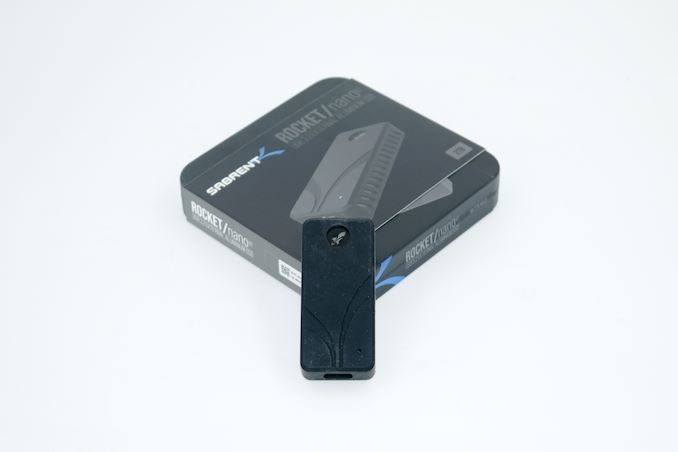
Sabrent's lineup of internal and external SSDs is popular among enthusiasts. The primary reason is the company's tendency to be among the first to market with products based on the latest controllers, while also delivering an excellent value proposition. The company has a long-standing relationship with Phison and adopts its controllers for many of their products. The company's 2 GBps-class portable SSD - the Rocket nano V2 - is based on Phison's U18 native controller. Read on for a detailed look at the Rocket nano V2 External SSD, including an analysis of its performance consistency, power consumption, and thermal profile.
The Endorfy Fortis 5 Dual Fan CPU Cooler Review: Towering Value
Published: Aug 27nd 2024 8:00am on AnandTech
Standard CPU coolers, while adequate for managing basic thermal loads, often fall short in terms of noise reduction and superior cooling efficiency. This limitation drives advanced users and system builders to seek aftermarket solutions tailored to their specific needs. The high-end aftermarket cooler market is highly competitive, with manufacturers striving to offer products with exceptional performance.
Endorfy, previously known as SilentiumPC, is a Polish manufacturer that has undergone a significant transformation to expand its presence in global markets. The brand is known for delivering high-performance cooling solutions with a strong focus on balancing efficiency and affordability. By rebranding as Endorfy, the company aims to enter premium market segments while continuing to offer reliable, high-quality cooling products.
SilentiumPC became very popular in the value/mainstream segments of the PC market with their products, the spearhead of which probably was the Fera 5 cooler that we reviewed a little over two years ago and had a remarkable value for money. Today’s review places Endorfy’s largest CPU cooler, the Fortis 5 Dual Fan, on our laboratory test bench. The Fortis 5 is the largest CPU air cooler the company currently offers and is significantly more expensive than the Fera 5, yet it still is a single-tower cooler that strives to strike a balance between value, compatibility, and performance.
ACEMAGIC F2A 125H SFF PC Review: Mid-Range Meteor Lake at 65W
Published: Aug 26nd 2024 8:00am on AnandTech
Intel's Meteor Lake series of processors was launched in September 2023 with a focus on mobile platforms. Multiple mini-PC vendors have utilized these processors to market offerings in the SFF / UCFF desktop market. ACEMAGIC is an Asian manufacturer with products in multiple categories including micro-PCs, UCFF (ultra-compact form-factor) and SFF (small form-factor) PCs, and notebooks. They were one of the first to market with Meteor Lake-based desktop systems.
The ACEMAGIC F2A 125H is the entry-level version of the F2A line, equipped with an Intel Core Ultra 5 125H processor. It is a bit larger than the traditional NUCs, slotting it in the SFF category. However, that allows for the processor to be operated at 65W (compared to the 28 - 40W adopted in the UCFF systems). Read on for a comprehensive look at the performance and features of the ACEMAGIC F2A 125H, including some comments on the pros and cons of the higher operating power as well as other design decisions.
MediaTek to Add NVIDIA G-Sync Support to Monitor Scalers, Make G-Sync Displays More Accessible
Published: Aug 20nd 2024 5:30am on AnandTech
NVIDIA on Tuesday said that future monitor scalers from MediaTek will support its G-Sync technologies. NVIDIA is partnering with MediaTek to integrate its full range of G-Sync technologies into future monitors without requiring a standalone G-Sync module, which makes advanced gaming features more accessible across a broader range of displays.
Traditionally, G-Sync technology relied on a dedicated G-sync module – based on an Altera FPGA – to handle syncing display refresh rates with the GPU in order to reduce screen tearing, stutter, and input lag. As a more basic solution, in 2019 NVIDIA introduced G-Sync Compatible certification and branding, which leveraged the industry-standard VESA AdaptiveSync technology to handle variable refresh rates. In lieu of using a dedicated module, leveraging AdaptiveSync allowed for cheaper monitors, with NVIDIA's program serving as a stamp of approval that the monitor worked with NVIDIA GPUs and met NVIDIA's performance requirements. Still, G-Sync Compatible monitors still lack some features that, to date, require the dedicated G-Sync module.
Through this new partnership with MediaTek, MediaTek will bring support for all of NVIDIA's G-Sync technologies, including the latest G-Sync Pulsar, directly into their scalers. G-Sync Pulsar enhances motion clarity and reduces ghosting, providing a smoother gaming experience. In addition to variable refresh rates and Pulsar, MediaTek-based G-Sync displays will support such features as variable overdrive, 12-bit color, Ultra Low Motion Blur, low latency HDR, and Reflex Analyzer. This integration will allow more monitors to support a full range of G-Sync features without having to incorporate an expensive FPGA.
The first monitors to feature full G-Sync support without needing an NVIDIA module include the AOC Agon Pro AG276QSG2, Acer Predator XB273U F5, and ASUS ROG Swift 360Hz PG27AQNR. These monitors offer 360Hz refresh rates, 1440p resolution, and HDR support.
What remains to be seen is which specific MediaTek's scalers will support NVIDIA's G-Sync technology – or if the company is going to implement support into all of their scalers going forward. It also remains to be seen whether monitors with NVIDIA's dedicated G-Sync modules retain any advantages over displays with MediaTek's scalers.
Qualcomm Adds Snapdragon 7s Gen 3: Mid-Tier Snapdragon Gets Cortex-A720 Treatment
Published: Aug 20nd 2024 9:00am on AnandTech
Qualcomm this morning is taking the wraps off of a new smartphone SoC for the mid-range market, the Snapdragon 7s Gen 3. The second of Qualcomm’s down-market ‘S’ tier Snapdragon 7 parts, the 7s series is functionally the entry-level tier for the Snapdragon 7 family – and really, most Qualcomm-powered handsets in North America.
With three tiers of Snapdragon 7 chips, the 7s can easily be lost in the noise that comes with more powerful chips. But the latest iteration of the 7s is a bit more interesting than usual, as rather than reusing an existing die, Qualcomm has seemingly minted a whole new die for this part. As a result, the company has upgraded the 7s family to use Arm’s current Armv9 CPU cores, while using bits and pieces of Qualcomm’s latest IPs elsewhere.
Qualcomm Snapdragon 7-Class SoCs SoC Snapdragon 7 Gen 3 (SM7550-AB) Snapdragon 7s Gen 3 (SM7635) Snapdragon 7s Gen 2 (SM7435-AB) CPU 1x Cortex-A715 @ 2.63GHz 3x Cortex-A715 @ 2.4GHz 4x Cortex-A510 @ 1.8GHz 1x Cortex-A720 @ 2.5GHz 3x Cortex-A720 @ 2.4GHz 4x Cortex-A520 @ 1.8GHz 4x Cortex-A78 @ 2.4GHz 4x Cortex-A55 @ 1.95GHz GPU Adreno Adreno Adreno DSP / NPU Hexagon Hexagon Hexagon Memory Controller 2x 16-bit CH @ 3200MHz LPDDR5 / 25.6GB/s @ 2133MHz LPDDR4X / 17.0GB/s 2x 16-bit CH @ 3200MHz LPDDR5 / 25.6GB/s @ 2133MHz LPDDR4X / 17.0GB/s 2x 16-bit CH @ 3200MHz LPDDR5 / 25.6GB/s @ 2133MHz LPDDR4X / 17.0GB/s ISP/Camera Triple 12-bit Spectra ISP 1x 200MP or 64MP with ZSL or 32+21MP with ZSL or 3x 21MP with ZSL 4K HDR video & 64MP burst capture Triple 12-bit Spectra ISP 1x 200MP or 64MP with ZSL or 32+21MP with ZSL or 3x 21MP with ZSL 4K HDR video & 64MP burst capture Triple 12-bit Spectra ISP 1x 200MP or 48MP with ZSL or 32+16MP with ZSL or 3x 16MP with ZSL 4K HDR video & 48MP burst capture Encode/ Decode 4K60 10-bit H.265 H.265, VP9 Decoding Dolby Vision, HDR10+, HDR10, HLG 1080p120 SlowMo 4K60 10-bit H.265 H.265, VP9 Decoding HDR10+, HDR10, HLG 1080p120 SlowMo 4K60 10-bit H.265 H.265, VP9 Decoding HDR10, HLG 1080p120 SlowMo Integrated Radio FastConnect 6700 Wi-Fi 6E + BT 5.3 2x2 MIMO FastConnect Wi-Fi 6E + BT 5.4 2x2 MIMO FastConnect 6700 Wi-Fi 6E + BT 5.2 2x2 MIMO Integrated Modem X63 Integrated (5G NR Sub-6 + mmWave) DL = 5.0 Gbps 5G/4G Dual Active SIM (DSDA) Integrated (5G NR Sub-6 + mmWave) DL = 2.9 Gbps 5G/4G Dual Active SIM (DSDA) X62 Integrated (5G NR Sub-6 + mmWave) DL = 2.9 Gbps 5G/4G Dual Active SIM (DSDA) Mfc. Process TSMC N4P TSMC N4P Samsung 4LPEOfficially, the Snapdragon 7s is classified as a 1+3+4 design – meaning there’s 1 prime core, 3 performance cores, and 4 efficiency cores. In this case, Qualcomm is using the same architecture for both the prime and efficiency cores, Arm’s current-generation Cortex-A720 design. The prime core gets to turbo as high as 2.5GHz, while the remaining A720 cores will turbo as high as 2.4GHz.
These are joined by the 4 efficiency cores, which, as is tradition, are based upon Arm’s current A5xx cores, in this case, A520. These can boost as high as 1.8GHz.
Compared to the outgoing Snapdragon 7s Gen 2, the switch in Arm cores represents a fairly significant upgrade, replacing an A78/A55 setup with the aforementioned A720/A520 setup. Notably, clockspeeds are pretty similar to the previous generation part, so most of the unconstrained performance uplift on this generation is being driven by improvements in IPC, though the faster prime core should offer a bit more kick for single-threaded workloads.
All told, touting a 20% improvement in CPU performance over the 7s Gen 2, though that claim doesn’t clarify whether it’s single or multi-threaded performance (or a mixture of both).
Meanwhile, graphics are driven by one of Qualcomm’s Adreno GPUs. As is usually the case, the company is not offering any significant details on the specific GPU configuration being used – or even what generation it is. A high-level look at the specifications doesn’t reveal any major features that weren’t present in other Snapdragon 7 parts. And Qualcomm isn’t bringing high-end features like ray tracing down to such a modest part. That said, I’ve previously heard through the tea leaves that this may be a next-generation (Adreno 800 series) design; though if that’s the case, Qualcomm is certainly not trying to bring attention to it.
Curiously, however, the video decode block on the SoC seems rather dated. Despite this being a new die, Qualcomm has opted not to include AV1 decoding – or, at least, opted not to enable it – so H.265 and VP9 are the most advanced codecs supported.
Compared to CPU performance gains, Qualcomm’s expected GPU performance gains are more significant. The company is claiming that the7s Gem 3 will deliver a 40% improvement in GPU performance over the 7s Gen 2.
Finally, the Hexagon NPU block on the SoC incorporates some of Qualcomm’s latest IP, as the company continues their focused AI push across all of their chip segments. Notably, the version of the NPU used here gets INT4 support for low precision client inference, which is new to the Snapdragon 7s family. As with Qualcomm’s other Gen 3 SoCs, the big drive here is for local (on-device) LLM execution.
With regards to performance, Qualcomm says that customers should expect to see a 30% improvement in AI performance relative to the 7s Gen 2.
Feeding all of these blocks is a 32-bit memory controller. Interestingly, Qualcomm has opted to support older LPDDR4X even with this newer chip, so the maximum memory bandwidth depends on the memory type used. For LPDDR4X-4266 that will be 17GB/sec, and for LPDDR5-6400 that will be 25.6GB/sec. In both cases, this is identical to the bandwidth available for the 7s Gen 2.
Rounding out the package, the 7s Gen 3 does incorporate some newer/more powerful camera hardware as well. We’re still looking at a trio of 12-bit Spectra ISPs, but the maximum resolution in zero shutter lag and burst modes has been bumped up to 64MPix. Video recording capabilities are otherwise identical on paper, as the 7s Gen 2 already supported 4K HDR capture.
Meanwhile on the wireless communication side of matters, the 7s Gen 3 packs one of Qualcomm’s integrated Snapdragon 5G modems. As with its predecessor, the 7s Gen 3 supports both Sub-6 and mmWave bands, with a maximum (theoretical) throughput of 2.9Gbps.
Eagle-eyed chip watchers will note, however, that Qualcomm is doing away with any kind of version information as of this part. So while the 7s Gen 2 used a Snapdragon X62 modem, the 7s Gen 3’s modem has no such designation – it’s merely an integrated Snapdragon modem. According to the company, this change has been made to “simplify overall branding and to be consistent with other IP blocks in the chipset.”
Similarly, the Wi-Fi/Bluetooth block has lost its version number; it is now merely a FastConnect block. In regards to features and specifications, this appears to be the same Wi-Fi 6E block that we’ve seen in half a dozen other Snapdragon SoCs, offering 2 spatial streams at channel widths up to 160MHz. It is worth noting, however, that since this is a newer SoC it’s certified for Bluetooth 5.4 support, versus the 5.2/5.3 certification other Snapdragon 7 chips have carried.
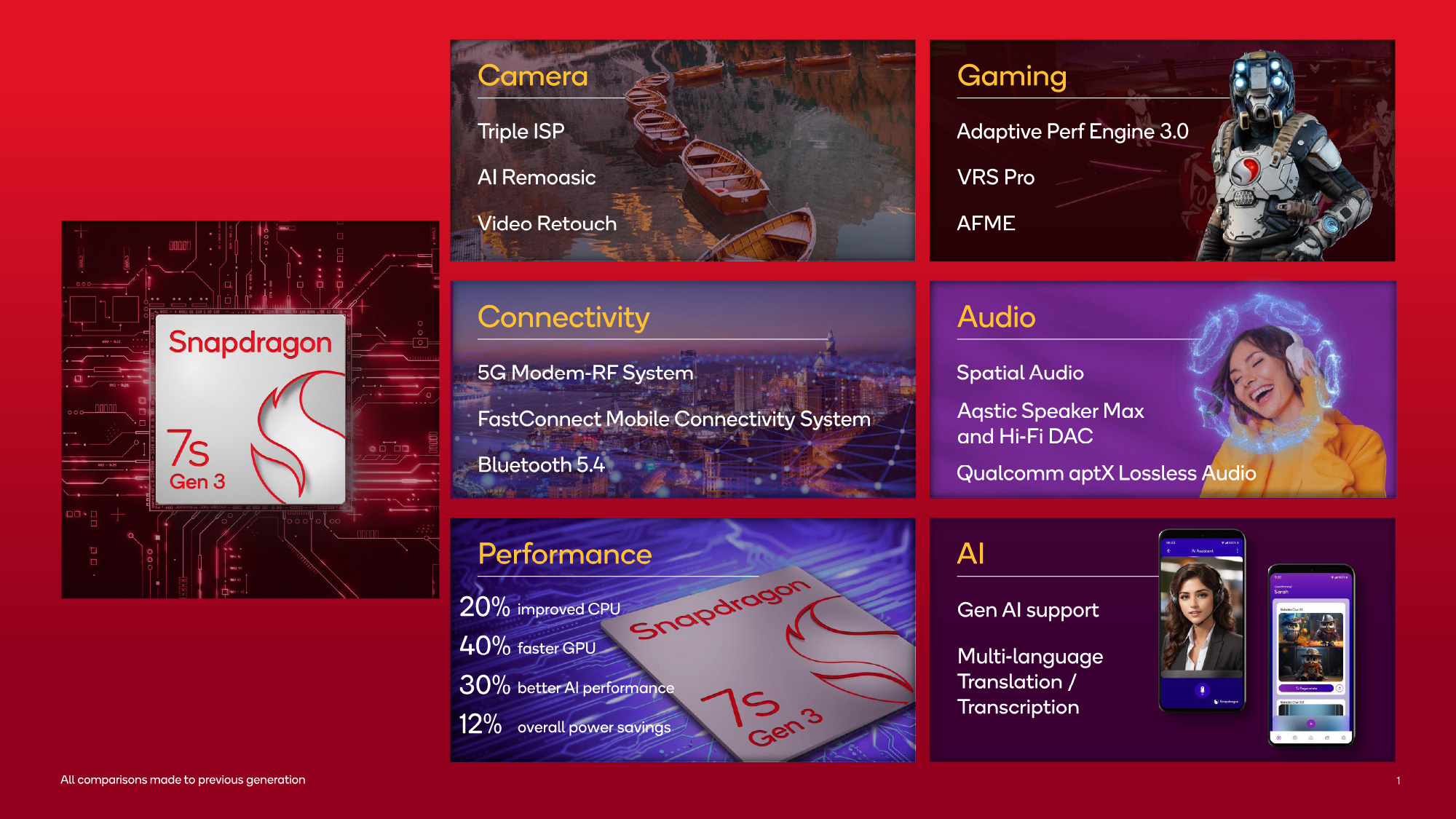
Finally, the Snapdragon 7s Gen 3 itself is being built on TSMC’s N4P process, the same process we’ve seen the last several Qualcomm SoCs use. And with this, Qualcomm has now fully migrated the entire Snapdragon 8 and Snapdragon 7 lines off of Samsung’s 4nm process nodes; all of their contemporary chips are now built at TSMC. And like similar transitions in the past, this shift in process nodes is coming with a boost to power efficiency. While it’s not the sole cause, overall Qualcomm is touting a 12% improvement in power savings.
Wrapping things up, Qualcomm’s launch customer for the Snapdragon 7s Gen 3 will be Xiaomi, who will be the first to launch a new phone with the chip. Following them will be many of the other usual suspects, including Realme and Sharp, while the much larger Samsung is also slated to use the chip at some point in the coming months.
CXL Gathers Momentum at FMS 2024
Published: Aug 19nd 2024 8:00am on AnandTech
The CXL consortium has had a regular presence at FMS (which rechristened itself from 'Flash Memory Summit' to the 'Future of Memory and Storage' this year). Back at FMS 2022, the company had announced v3.0 of the CXL specifications. This was followed by CXL 3.1's introduction at Supercomputing 2023. Having started off as a host to device interconnect standard, it had slowly subsumed other competing standards such as OpenCAPI and Gen-Z. As a result, the specifications started to encompass a wide variety of use-cases by building a protocol on top of the the ubiquitous PCIe expansion bus. The CXL consortium comprises of heavyweights such as AMD and Intel, as well as a large number of startup companies attempting to play in different segments on the device side. At FMS 2024, CXL had a prime position in the booth demos of many vendors.
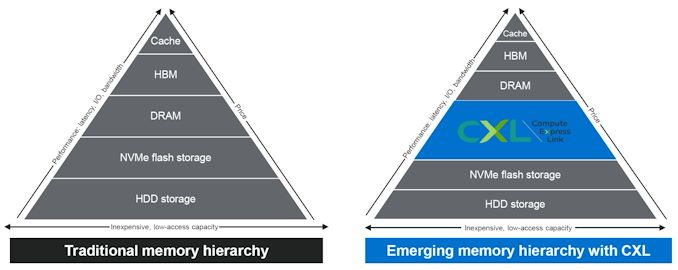
The migration of server platforms from DDR4 to DDR5, along with the rise of workloads demanding large RAM capacity (but not particularly sensitive to either memory bandwidth or latency), has opened up memory expansion modules as one of the first set of widely available CXL devices. Over the last couple of years, we have had product announcements from Samsung and Micron in this area.
SK hynix CMM-DDR5 CXL Memory Module and HMSDKAt FMS 2024, SK hynix was showing off their DDR5-based CMM-DDR5 CXL memory module with a 128 GB capacity. The company was also detailing their associated Heterogeneous Memory Software Development Kit (HMSDK) - a set of libraries and tools at both the kernel and user levels aimed at increasing the ease of use of CXL memory. This is achieved in part by considering the memory pyramid / hierarchy and relocating the data between the server's main memory (DRAM) and the CXL device based on usage frequency.
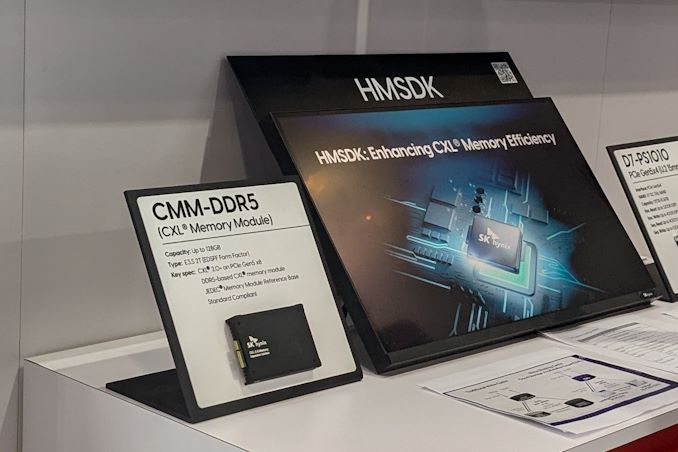
The CMM-DDR5 CXL memory module comes in the SDFF form-factor (E3.S 2T) with a PCIe 3.0 x8 host interface. The internal memory is based on 1α technology DRAM, and the device promises DDR5-class bandwidth and latency within a single NUMA hop. As these memory modules are meant to be used in datacenters and enterprises, the firmware includes features for RAS (reliability, availability, and serviceability) along with secure boot and other management features.
SK hynix was also demonstrating Niagara 2.0 - a hardware solution (currently based on FPGAs) to enable memory pooling and sharing - i.e, connecting multiple CXL memories to allow different hosts (CPUs and GPUs) to optimally share their capacity. The previous version only allowed capacity sharing, but the latest version enables sharing of data also. SK hynix had presented these solutions at the CXL DevCon 2024 earlier this year, but some progress seems to have been made in finalizing the specifications of the CMM-DDR5 at FMS 2024.
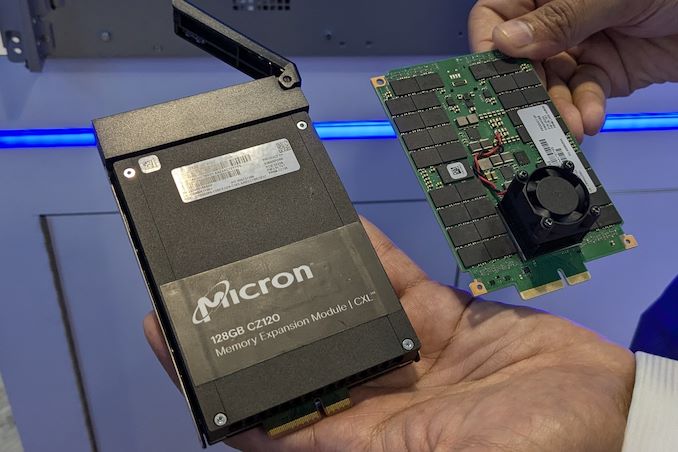
Microchip and Micron Demonstrate CZ120 CXL Memory Expansion ModuleMicron had unveiled the CZ120 CXL Memory Expansion Module last year based on the Microchip SMC 2000 series CXL memory controller. At FMS 2024, Micron and Microchip had a demonstration of the module on a Granite Rapids server.
Additional insights into the SMC 2000 controller were also provided.
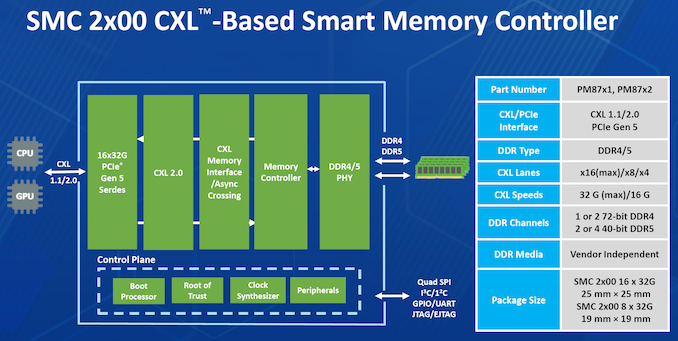
The CXL memory controller also incorporates DRAM die failure handling, and Microchip also provides diagnostics and debug tools to analyze failed modules. The memory controller also supports ECC, which forms part of the enterprise class RAS feature set of the SMC 2000 series. Its flexibility ensures that SMC 2000-based CXL memory modules using DDR4 can complement the main DDR5 DRAM in servers that support only the latter.
Marvell Announces Structera CXL Product LineA few days prior to the start of FMS 2024, Marvell had announced a new CXL product line under the Structera tag. At FMS 2024, we had a chance to discuss this new line with Marvell and gather some additional insights.
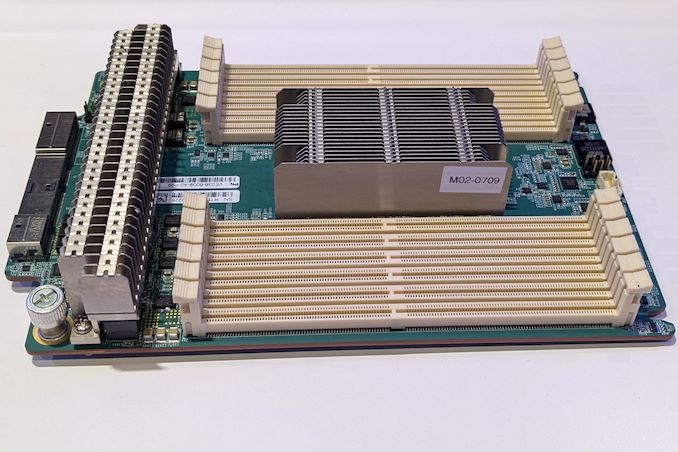
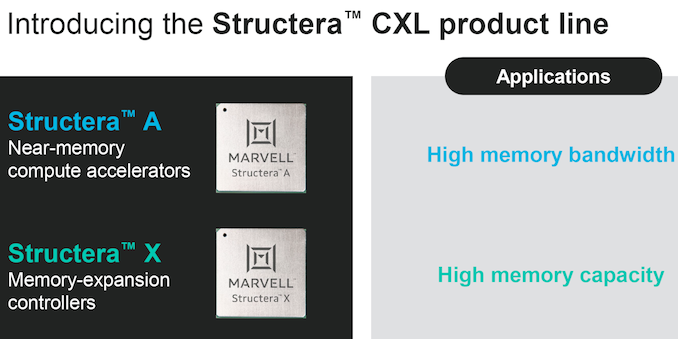
Unlike other CXL device solutions focusing on memory pooling and expansion, the Structera product line also incorporates a compute accelerator part in addition to a memory-expansion controller. All of these are built on TSMC's 5nm technology.
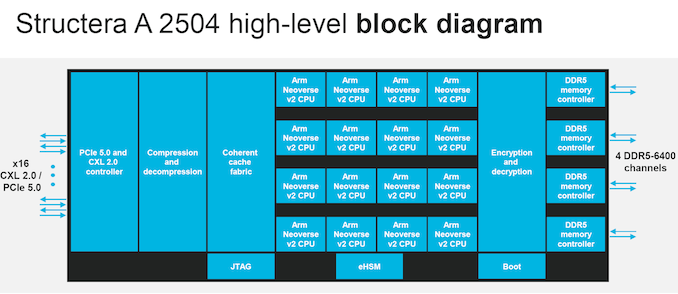
The compute accelerator part, the Structera A 2504 (A for Accelerator) is a PCIe 5.0 x16 CXL 2.0 device with 16 integrated Arm Neoverse V2 (Demeter) cores at 3.2 GHz. It incorporates four DDR5-6400 channels with support for up to two DIMMs per channel along with in-line compression and decompression. The integration of powerful server-class ARM CPU cores means that the CXL memory expansion part scales the memory bandwidth available per core, while also scaling the compute capabilities.
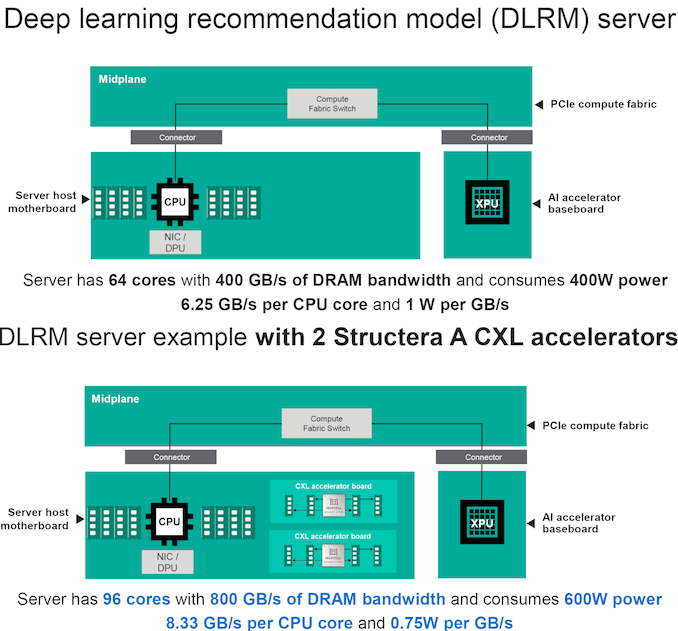
Applications such as Deep-Learning Recommendation Models (DLRM) can benefit from the compute capability available in the CXL device. The scaling in the bandwidth availability is also accompanied by reduced energy consumption for the workload. The approach also contributed towards disaggregation within the server for a better thermal design as a whole.
The Structera X 2404 (X for eXpander) will be available either as a PCIe 5.0 (single x16 or two x8) device with four DDR4-3200 channels (up to 3 DIMMs per channel). Features such as in-line (de)compression, encryption / decryption, and secure boot with hardware support are present in the Structera X 2404 as well. Compared to the 100 W TDP of the Structera X 2404, Marvell expects this part to consume around 30 W. The primary purpose of this part is to enable hyperscalers to recycle DDR4 DIMMs (up to 6 TB per expander) while increasing server memory capacity.
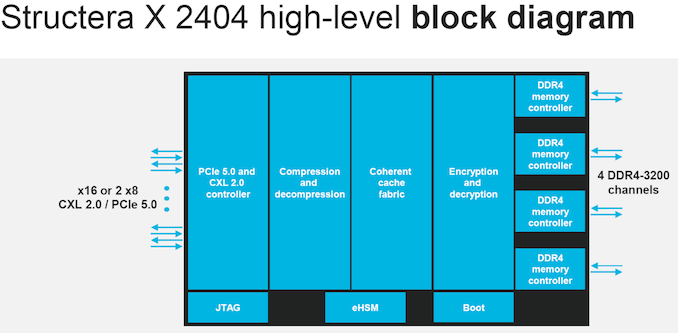
Marvell also has a Structera X 2504 part that supports four DDR5-6400 channels (with two DIMMs per channel for up to 4 TB per expander). Other aspects remain the same as that of the DDR4-recycling part.
The company stressed upon some unique aspects of the Structera product line - the inline compression optimizes available DRAM capacity, and the 3 DIMMs per channel support for the DDR4 expander maximizes the amount of DRAM per expander (compared to competing solutions). The 5nm process lowers the power consumption, and the parts support accesses from multiple hosts. The integration of Arm Neoverse V2 cores appears to be a first for a CXL accelerator, and enables delegation of compute tasks to improve overall performance of the system.
While Marvell announced specifications for the Structera parts, it does appear that sampling is at least a few quarters away. One of the interesting aspects about Marvell's roadmaps / announcements in recent years has been their focus on creating products tuned to the demands of high-volume customers. The Structera product line is no different - hyperscalers are hungry to recycle their DDR4 memory modules and apparently can't wait to get their hands on the expander parts.
CXL is just starting its slow ramp-up, and the hockey stick segment of the growth curve is definitely definitely not in the near term. However, as more host systems with CXL support start to get deployed, products like the Structera accelerator line start to make sense from a server efficiency viewpoint.
Gallery: CXL Gathers Momentum at FMS 2024


