Crucial P310 NVMe SSD Unveiled: Micron's Play in the M.2 2230 Market
Published: Jul 17nd 2024 9:00am on AnandTech
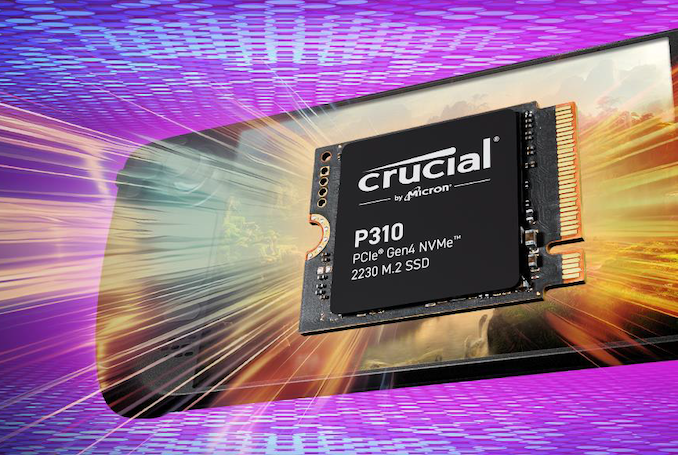
Hand-held gaming consoles based on notebook platforms (such as the Valve SteamDeck, ASUS ROG Ally, and the MSI Claw) are one of the fastest growing segments in the PC gaming market. The form-factor of such systems has created a demand for M.2 2230 NVMe SSDs. Almost all vendors have a play in this market, and even Micron has OEM SSDs (such as the Micron 2400, 2550, and 2500 series) in this form-factor. Crucial has strangely not had an offering with its own brand name to target this segment, but that changes today with the launch of the Crucial P310 NVMe SSD.
The Crucial P310 is a family of M.2 2230 PCIe Gen4 NVMe SSDs boasting class-leading read/write speeds of 7.1 GBps and 6 GBps. The family currently has two capacity points - 1 TB and 2 TB. Micron claims that the use of its 232L 3D NAND and Phison's latest E27T DRAM-less controller (fabricated in TSMC's 12nm process) help in reducing power consumption under active use compared to the competition - directly translating to better battery life for the primary use-case involving gaming handheld consoles.
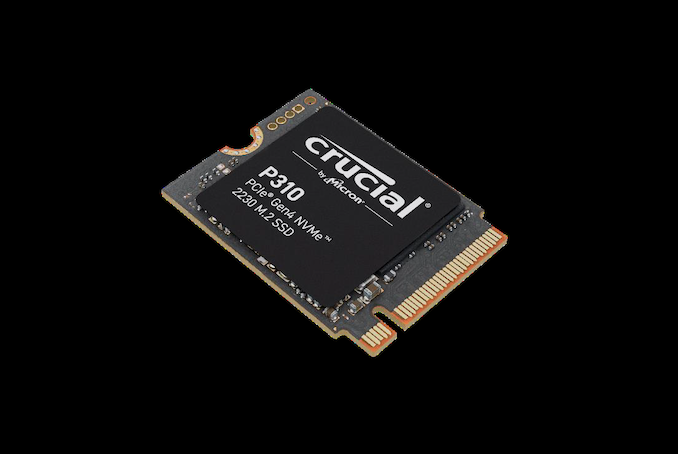
Based on the specifications, it appears that the drives are using 232L 3D QLC, and we have reached out to Micron to confirm the same. Compared to the recently-released Micron 2550 SSD series in the same form-factor, a swap in the controller has enabled some improvements in both power efficiency and performance. The other specifications are summarized in the table below.
Crucial P310 SSD Specifications Capacity 2 TB 1 TB Controller Phison E27T (DRAM-less) NAND Flash Micron 232L 3D NAND (QLC?) Form-Factor, Interface Single-Sided M.2-2230 PCIe 4.0 x4, NVMe Sequential Read 7100 MB/s Sequential Write 6000 MB/s Random Read IOPS 1 M Random Write IOPS 1.2 M SLC Caching Yes TCG Pyrite Encryption Yes Warranty 5 Years Write Endurance 440 TBW 0.12 DWPD 220 TBW 0.12 DWPD MSRP $215 $115The power efficiency, cost, and capacity points are plus points for the Crucial P310 family. However, the endurance ratings are quite low. Gaming workloads are inherently read-heavy, and this may not be a concern for the average consumer. However, a 0.12 DWPD rating may turn out to be a negative aspect when compared against the competition's 0.33 DWPD offerings in the same segment.